In September 2026, Google handled 93.8% of all searches in Spain, with Bing a distant second at about 3.5% (StatCounter). Spain also had around 46.1 million internet users by October 2025, which is 96.4% of the population (DataReportal). Put those two numbers together and the conclusion is simple. Whether you run a tapas bar in Malasaña, a reformas company in Valencia or an online shop shipping from Barcelona, your next customer is typing it into Google on their phone right now.
So why do so many Spanish business owners tell me, “Google Ads no nos funciona”?
A while ago I had a first call with the owner of a hospitality business on the coast. She had been paying an agency for “gestión de Google Ads” for a year and shared her screen with me. Plenty of clicks, a nice click-through rate, and a conversion column full of numbers. Then she showed me her booking system, and the two had nothing to do with each other. Every tap on the WhatsApp button was being counted as a booking, the cookie banner had no reject button, and the same campaign ran at the same budget in February as in August. Google Ads wasn’t failing her. The way it was managed was.
That is what this guide is about. I’ll walk you through how Google Ads works in Spain in 2026, what it really costs, which campaign types fit which business, how Spanish privacy rules change your tracking, the mistakes I see most often, and how to tell whether your ads are making money. Think of it as the first meeting I’d have with you as a client, before any proposal is on the table.
Key takeaways
- Google Ads captures demand that already exists. Meta ads create demand. Most Spanish businesses need both, but high-intent services should start with Google Search.
- There is no reliable published “price list” for Google Ads in Spain. Your cost per click comes from the auction, and you should estimate it with Keyword Planner and a small test, not a number from a blog.
- In Spain, tracking is a legal question as well as a technical one. Consent Mode v2 and an AEPD-compliant cookie banner decide how much data Google can learn from.
- Region, language and season matter more here than in most markets: Madrid is not Girona, and August is not February.
- Give a properly built account 30 to 90 days, and judge it on cost per qualified lead or ROAS, not clicks.
Is Google Ads worth it for businesses in Spain in 2026?
Yes, for any business whose customers search before they buy. That covers hospitality, tourism, home services, clinics, lawyers, education, B2B suppliers and most e-commerce categories. The reason is intent. Someone searching “fontanero urgente Madrid” or “abogado de extranjería Barcelona” has already decided they need help. Your ad appears at the moment they are deciding who to call.
The same is true when a business owner searches for help with their own ads. Queries like “agencia Google Ads Madrid”, “gestión de Google Ads” or “consultor SEM” are typed by people who already know they have a problem. That is the kind of demand Google Search is built to catch.
Who is searching on Google in Spain right now?
Almost everyone, and mostly on a phone. According to DataReportal’s Digital 2026 report, Spain had 46.1 million internet users and 56.1 million cellular connections by late 2025, and YouTube’s advertising reach was about 39.0 million people. In September 2026, 68.3% of web traffic in Spain came from mobile devices and only about 30% from desktop (StatCounter).
Four groups matter most for advertisers:
- Local customers in the big cities: Madrid, Barcelona, Valencia, Sevilla, Málaga and Bilbao, searching for services, restaurants, clinics and trades “cerca de mí”.
- International visitors, who search in English, French and German before and during their trip. Spain received a record 96.8 million international tourists in 2025, with about 19.1 million from the UK, 12.8 million from France and 12.0 million from Germany (INE, Frontur).
- Catalan, Valencian and Balearic audiences, where the language of your ad can change how local and trustworthy you look.
- B2B buyers researching suppliers, software and contractors. They rarely click social ads but search Google repeatedly before they ask for a quote.
Google Ads vs Meta ads: which brings better leads in Spain?
They do different jobs. Google Search captures people who already want what you sell, so lead quality is usually higher and volume is limited by search demand. Meta (Facebook and Instagram) reaches people before they search, so it suits new products, visual offers and events. In Spain there is a third player in every funnel: WhatsApp. In IAB Spain’s 2025 social media study, 92% of social media users aged 12 to 74 said they use WhatsApp (Marketing4eCommerce / IAB Spain). Your ads will often end in a chat, not a form.
| Factor | Google Ads (Search) | Meta ads (Facebook & Instagram) |
|---|---|---|
| Buyer intent | High: the person is actively searching | Low to medium: you interrupt their scroll |
| Best for | Services, urgent needs, B2B, high-ticket purchases, bookings | Restaurants, fashion, events, new products, visual offers |
| Cost per click | Usually higher | Usually lower |
| Lead quality | Usually higher | Mixed; needs qualifying questions |
| Typical next step in Spain | Call, WhatsApp chat or booking form | Instagram DM, WhatsApp chat or retargeting |
| Typical role | Capture demand and close | Create demand and retarget |
In my accounts the strongest results come from running both: Google to catch buyers who are ready, and Meta to build awareness and bring back visitors who left without booking. If people already search for your product, start with Google. If they don’t search for it yet, start with Facebook and Instagram ads.
How much does Google Ads cost in Spain, and how does the auction work?
Google Ads is an auction, run again for every single search. You never pay a fixed price per click. You pay just enough to beat the advertiser ranked below you, and that depends on their bids, your bid and the quality of your ad.
How the Google Ads auction decides your cost per click
Every time someone searches, Google ranks ads using Ad Rank. Ad Rank combines your bid with your Quality Score: how relevant your ad is to the search, how likely people are to click it, and how good your landing page experience is. A well-built account with high Quality Scores can rank above a competitor while paying less per click.
That is why two clinics in the same Madrid barrio can pay very different amounts for the same keyword. One sends “implantes dentales Chamberí” to a page about implants in Chamberí, with prices and a WhatsApp button. The other sends every search to its homepage. Google rewards the first and taxes the second.
How much budget do you need to start Google Ads in Spain?
Here I have to be honest with you. I looked for a trustworthy, published benchmark of Google Ads costs in euros for Spain, by sector, and I couldn’t find one I would put my name to. Most “CPC medio en España” figures online come from agencies selling a service, with no method behind them. So I won’t give you a number. I’ll give you the method I use with clients instead:
Monthly budget = target leads (or sales) per month × expected cost per lead (or sale)
- Open Keyword Planner in your own account, set the location to your city or region and the language to Spanish (and Catalan if relevant), and note the forecast cost per click range for your real keywords.
- Assume a conservative conversion rate for your landing page until you have your own data.
- Run a test month with enough budget to collect real clicks, then replace the forecast with your actual cost per click and conversion rate.
Purely to show the arithmetic: if your test month shows a cost per lead of €40 and you need 50 leads a month, your working budget is €2,000 a month. Your numbers will be different, and that is the point. For an international reference, LocaliQ’s 2026 benchmarks across thousands of mostly US accounts are below. Use them to compare industries with each other, not as Spanish prices.
| Benchmark (Search ads, 2026, mostly US) | All industries | Restaurants & food | Travel | Sports & recreation | Real estate |
|---|---|---|---|---|---|
| Average cost per click | $5.42 | $2.05 | $2.14 | $2.77 | $3.22 |
| Click-through rate | 6.64% | 6.83% | 9.32% | 8.75% | 7.61% |
| Conversion rate | 8.18% | 8.05% | 5.83% | 7.69% | 3.70% |
| Cost per lead | $66.69 | $30.57 | $44.70 | $44.26 | $102.51 |
Source: LocaliQ search advertising benchmarks, mostly US accounts, in US dollars. Not Spanish prices.
The lesson in that table isn’t the dollar figures. Real estate has cheap clicks and an expensive cost per lead, because property buyers click a lot and enquire rarely. Travel has a high click-through rate but a lower conversion rate, because people compare a lot before they book. In niches like these, the landing page decides your profit, not the click price.
A practical rule: give a new account enough budget to collect at least 30 conversions a month. Below that, Google’s automated bidding has too little data to learn from, and every decision becomes a guess.
How do tourism seasons change Google Ads in Spain?
More than most owners expect. With nearly 97 million international visitors a year, coastal and city businesses compete with hotels, tour operators and booking platforms for the same searches in peak months. INE recorded about 5.3 million international tourists in December 2025, against a 2025 monthly average of roughly 8 million (INE, Frontur).
What that means in practice:
- Plan budgets by month, not as one flat daily figure. Use seasonality adjustments for short, predictable peaks such as Semana Santa, a local festival or a long weekend.
- Run tourist campaigns separately from local ones, in the visitor’s language, and target people both in Spain and in their home country before they travel.
- Start event campaigns early. For a fine-dining restaurant I worked with, every big date got its own campaign two weeks ahead, when people actually plan. That was on Facebook and Instagram, but the timing principle is the same on Google.
Which Google Ads campaign types work best for Spanish businesses?
Google offers seven main campaign types, and choosing the wrong one is one of the fastest ways to burn a budget. Here is how they compare and who each one suits in Spain.
| Campaign type | Where ads show | Best for in Spain | Watch out for |
|---|---|---|---|
| Search | Google search results | Services, clinics, trades, B2B, legal, local bookings | Needs negative keywords; limited by search volume |
| Performance Max | Search, YouTube, Display, Gmail, Maps, Discover | E-commerce and lead gen with solid conversion data | Little transparency; can take credit for brand searches |
| Shopping | Product listings with image and price | Online shops selling in Spain and across the EU | Needs a clean Merchant Center feed in Spanish |
| YouTube / Video | YouTube and video partners | Explaining a product, retargeting, tourism inspiration | Rarely closes sales alone |
| Demand Gen | YouTube Shorts, Discover, Gmail | Visual products, hospitality, fashion | Needs strong images and video |
| Display | Websites and apps | Retargeting, cheap reach | Low-quality placements and accidental clicks |
| App | Play Store, search, YouTube | App installs and in-app actions | Optimise for actions, not just installs |
Search vs Performance Max: which should you run first?
For most Spanish businesses, Search first. Search gives you control: you choose the keywords, read the actual search terms, block the irrelevant ones and write ads for each intent. It also builds the conversion data that automation needs.
Performance Max is powerful once you have that data, typically 30 or more conversions a month and clean tracking. Launch it on day one with a new account and it will hunt for the cheapest conversions it can find, which is often your own brand name or low-quality form fills. I usually add it once Search is profitable, with brand exclusions and separate asset groups for each product or service line.
Local campaigns in Madrid, Barcelona and Valencia: how should you target them?
Treat each city as its own market. Competition, search terms and even opening hours differ. A reformas company might bid on “reformas integrales Valencia” and “reforma cocina Valencia precio” in one campaign, and run Madrid in a separate campaign with its own budget, ads and landing page. That way you can see which city actually makes money, and Google can’t quietly move your budget to the cheaper one.
Three settings I check in every Spanish account:
- Location option set to “presence” (people in or regularly in your area) for local services, so you don’t pay for someone in Buenos Aires reading about Madrid.
- Radius or postcode targeting around each branch, with bid adjustments for the barrios that convert.
- Ad schedule matched to when you can answer the phone or WhatsApp, including the long Spanish lunch break and late evenings.
Should you run Google Ads in Spanish, Catalan or both?
It depends on where you are and who you sell to. In Catalonia, Catalan use varies a lot by area. Idescat’s 2023 language survey found that the share of people aged 15 and over who use only Catalan as their habitual language ranged from 24.7% in the Barcelona metropolitan area to 66.8% in Terres de l’Ebre (Idescat, EULP 2023). An ad in Catalan can feel much more local in Girona or Lleida than in central Barcelona.
My approach: run Spanish ads everywhere, then test Catalan ad groups (and Catalan landing pages) in Catalan-speaking areas, with Catalan language targeting switched on. Write them natively, not through a translator. “Restaurant a Girona” and “restaurante en Girona” are different searches with different competition. Then let the data decide. The same logic applies to Valencian in the Comunitat Valenciana and to English, French and German for tourist areas.
Your free marketing strategy starts with your numbers
Move the sliders to see what your budget could return. Then get a free strategy built for your business: the right platforms, your budget split and your first 30 days.
Estimates based on Saad's campaign benchmarks across 26 niches. Not a guarantee. Your free strategy gives you a real plan.
Create your free strategy
- The right platforms, and what to post
- Your paid ads plan and budget split
- Your first 30 days, week by week
Want more? Stage 2 Advanced Strategy, EUR 18 or hire me and my team for 100% digital coverage.
What does professional Google Ads management in Spain include?
Good management is 20% setup and 80% ongoing decisions. In Spain there is an extra layer: privacy law shapes what you can track. Here is what should happen in a well-run account.
| Area | What it involves | How often |
|---|---|---|
| Account audit & structure | Campaigns grouped by intent, city and language; no overlap between campaigns | At the start, then quarterly |
| Consent & tracking | AEPD-compliant cookie banner, Consent Mode v2, GA4, Tag Manager, enhanced conversions, call and WhatsApp tracking, CRM imports | At the start, then checked weekly |
| Keywords & negatives | Adding winning searches, blocking irrelevant ones such as “gratis” or “empleo” | Weekly |
| Ads & assets | Testing headlines, offers, sitelinks, images and calls, in each language | Every 2–4 weeks |
| Bids & budgets | Choosing bid strategies; moving budget by season and to what converts | Weekly |
| Landing pages | One focused, fast mobile page per campaign theme | Monthly |
| Reporting | Leads, bookings, sales, CPA and ROAS in plain language | Monthly, with weekly checks |
Consent Mode v2 and RGPD: is your Google Ads tracking legal and accurate?
Spanish websites have to follow the EU’s GDPR (RGPD in Spain), Spain’s own data protection law, the Ley Orgánica 3/2018 (LOPDGDD), and article 22.2 of the LSSI (Ley 34/2002), which says non-essential cookies need the user’s informed consent. On 11 July 2023 the Spanish data protection authority, the AEPD, updated its cookie guide. Since 11 January 2024, a reject option must appear in the first layer of the banner, and accept and reject must be equally visible (ECIJA summary of the AEPD guide).
Google’s side of this is Consent Mode v2. It adds two signals, ad_user_data and ad_personalization, that tell Google what each visitor agreed to (Google Tag Manager Help). Since March 2024, advertisers who don’t send these signals for users in the EEA lose remarketing and personalised advertising there (Search Engine Journal).
Two practical points. First, a banner that hides the reject button might lift your consent rate for a while, but it is exactly what the AEPD guide rules out, and it is not worth the risk. Second, with a compliant banner some people will always reject, so your Google Ads conversion count will be lower than your real sales. That is normal. Enhanced conversions, offline imports from your CRM and server-side tagging help close the gap within the rules. I always set up tracking this way before scaling a Spanish account. You can read more on our tracking and CRO service page.
How do you track WhatsApp and phone leads from Google Ads?
Carefully, because this is where most Spanish accounts lie to their owners. A tap on a WhatsApp button is not a lead. Many people tap, look at the chat and never write. Count every tap as a conversion and Google will find you more tappers, not more customers.
What I set up instead: call tracking with a minimum call length, a separate “WhatsApp click” action used for observation only, and a real lead conversion recorded when a chat or call becomes a qualified enquiry in your CRM or booking system. That last step is the one Google should bid on.
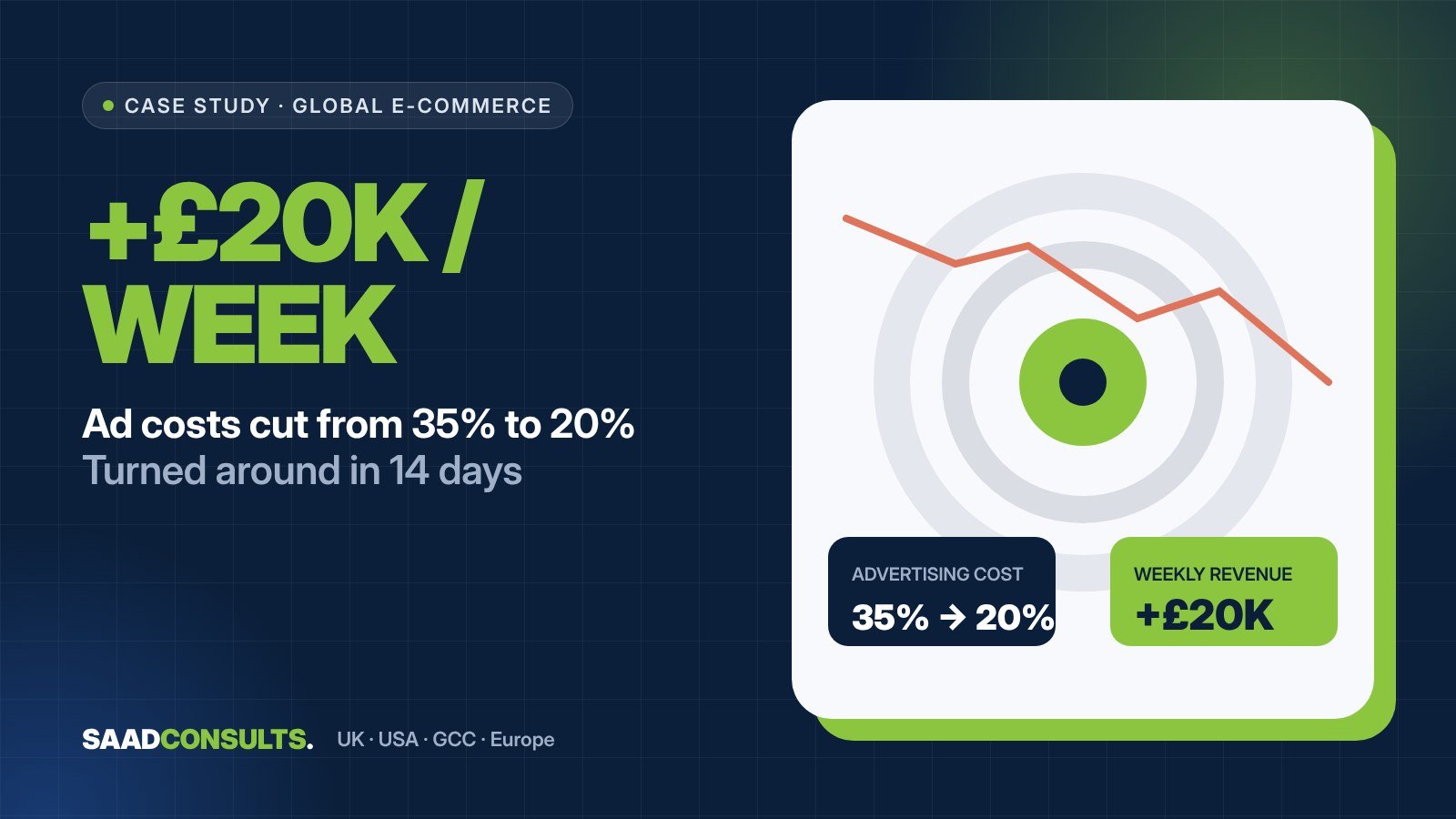
This matters most when budgets are tight. For an international combat sports e-commerce brand selling across Spain and Europe, Performance Max and Meta were chasing cheap conversions instead of high-value buyers. Retraining them on the right signals and splitting the catalogue into product tiers cut the advertising cost of sale from 35% to 25% in 14 days. The same project also fixed a website migration where the language versions of the site were competing with the main domain, a classic risk for any business running Spanish, Catalan and English sites. The full story is in the combat sports e-commerce case study.
Agencia, freelancer or consultant: who should manage your Google Ads?
Each option can work. The question is what you need and how much risk you can afford.
| Option | Pros | Cons | Best for |
|---|---|---|---|
| Do it yourself | No fees; you know your business | Steep learning curve; costly trial and error; consent setup is easy to get wrong | Very small budgets and hands-on owners |
| Freelancer | Affordable; flexible | Quality varies widely; often execution only, no strategy or tracking | Simple accounts with clear goals |
| Agencia Google Ads | A team and processes | Senior people sell, juniors manage; long permanencia contracts; accounts sometimes owned by the agency | Larger brands needing many channels |
| Senior consultant | Senior experience on your account; strategy, tracking and execution joined up | Limited capacity; not the cheapest hourly rate | Businesses that need ROI, a turnaround or a second opinion |
Whichever you pick, insist on three things: you own the account, you see the real numbers, and you get a clear plan for the next 90 days.
Can Kit Digital pay for Google Ads management in 2026?
Don’t plan your 2026 budget around it. The last Kit Digital calls stopped accepting new applications on 31 October 2025 (Xataka). In January 2026, Orden TDF/39/2026 changed the programme rules so that unspent funds can be granted, without a new application, to businesses that were refused only because the money had run out. If you applied and were refused for that reason, check your file on the Red.es electronic office. If you never applied, there is no general call open to new applicants as I write this in October 2026.
What are the most common Google Ads mistakes businesses make in Spain?
I audit a lot of accounts. The same mistakes cause most of the waste, and none of them are about the size of the budget.
Why are my Google Ads getting clicks but no customers?
Usually broad keywords and no negative list. “Abogado laboralista” brings in people searching “abogado laboralista gratis”, “trabajo de abogado laboralista” and “cuánto cobra un abogado laboralista”. Each click costs money and many of them will never hire you.
Fix: review the search terms report weekly, build negatives such as “gratis”, “empleo”, “curso” and “plantilla” from day one, and use phrase or exact match until you have data.Is my cookie banner killing my Google Ads data?
Either way it can hurt. A banner with no reject button breaks the AEPD guidance. A banner installed without Consent Mode v2 sends Google no consent signals, so remarketing and personalised ads stop for EEA users and conversions go missing.
Fix: use a consent platform that supports Consent Mode v2, test it in Tag Manager preview, and add enhanced conversions and CRM imports so lost data is partly recovered within the rules.Sending every ad to the homepage
Someone searching “dentista urgente Valencia” on their phone lands on a homepage with a slider and twelve services. They leave. A focused page about emergency appointments, with hours, prices and a WhatsApp button, would have booked them.
Fix: one landing page per service, city and language, loading in under 3 seconds on mobile.Running the same budget in August as in February
Hospitality, tourism and many retail businesses in Spain have strong seasons. A flat daily budget runs out by lunchtime in peak months and wastes money in quiet ones. Machine-translated ads for tourists make it worse.
Fix: plan budgets by month, use seasonality adjustments for short peaks, and run native-language campaigns for visitors before and during their trip.Letting Google’s recommendations run the account
Auto-applied recommendations, broad match everywhere and “maximise clicks” bidding are designed to spend your budget, not protect your margin. Left unchecked, they can quietly push money into display placements such as mobile games.
Fix: turn off auto-apply, review each recommendation, and choose bid strategies based on your own conversion data.Judging results after one week
New campaigns go through a learning period. Pausing and changing everything in week one resets that learning and guarantees poor results.
Fix: agree a 30 to 60 day evaluation window with clear targets for cost per lead or ROAS before you start.How long does Google Ads take to work in Spain, and how do you measure ROI?
Search campaigns can bring leads on day one. Reliable, profitable results usually take 30 to 90 days, because that is how long it takes to collect enough data, clean out wasted searches and let bidding learn. In Spain, add one more step at the start: make sure consent and tracking are right before you spend serious money. Here is how that period usually runs in accounts I manage.
Which KPIs matter: cost per lead, CPA, ROAS or lead quality?
Clicks, impressions and click-through rate are diagnostic numbers. They tell you why something is happening. The numbers that tell you whether Google Ads is working sit further down the funnel.
| KPI | What it tells you | Use it when |
|---|---|---|
| Cost per qualified lead | What a real sales opportunity costs | Services, clinics, legal, B2B, real estate |
| Cost per booking | What a confirmed table, room or appointment costs | Restaurants, hotels, tourism, health |
| Cost per acquisition (CPA) | What a paying customer costs | You can track sales or sign-ups |
| ROAS | Revenue for every euro spent | E-commerce and online sales |
| Lead-to-sale rate | Whether the ads bring the right people | Always. Ask your sales team weekly |
| Impression share | How much available demand you’re capturing | Deciding whether to scale, especially before peak season |
How do you calculate ROAS and ROI for Google Ads?
ROAS = revenue from ads ÷ ad spend. As a simple example, if €10,000 of ads brings €45,000 in sales, your ROAS is 4.5.
ROI = (profit from ads − total cost) ÷ total cost. ROI includes your product margin, IVA and management fees, so it is the number that decides whether you’re actually making money. A 4.5 ROAS on a product with a 15% margin can still lose money, while a 2.5 ROAS on a 70% margin service can be very profitable. That is why I work from margins, not just ROAS. In the combat sports case, the target was a 22% cost of sale because that was where the margin stopped working, and every campaign decision was measured against it.
How Saad manages Google Ads for businesses in Spain
By now you know more about Google Ads than many people who sell it. You know it’s an auction that rewards relevance, that tracking decides what Google learns, that in Spain consent rules shape that tracking, that region, language and season change the plan, and that the costliest mistakes are invisible on a dashboard. The question is whether you want to spend the next six months learning this with your own budget, or have someone who has already made those mistakes on other people’s money fix them in the first 30 days.
I’m Saad. Since 2010 I’ve managed more than $200 million in ad spend across 30,000+ campaigns for 600+ clients in 26 industries, and since 2022 I’ve helped 50 declining businesses back to growth. I’ve run paid media and e-commerce growth for an international brand selling across Spain and Europe, and today I lead marketing for a group of seven luxury home improvement brands in the UAE. I work with Spanish businesses remotely, with calls in your business hours, campaigns in Spanish and Catalan written by native copywriters, and tracking set up with consent mode in line with European privacy law. You work with me directly, not with a junior account manager.
What you get in a free Google Ads audit
- A review of your account structure and wasted spend
- A check of your cookie banner, Consent Mode v2 and conversion tracking: are they legal, and are they counting the right things?
- Search terms you’re paying for that will never convert
- City, language and seasonal settings that are costing you money
- Landing page and WhatsApp follow-up issues costing you leads
- A clear 30-day action plan you can use with or without me
Industries I already know well
Hotels and restaurants, travel and tourism, e-commerce, sports brands, real estate, healthcare, home improvement and many more industries.
No pitch, no lock-in contract, and you keep ownership of your account. If I don’t think I can improve your results, I’ll tell you. Request your free Google Ads audit, see how I work on the Google Ads management page for Spain, get in touch, or message me on WhatsApp at +92 333 1414145.
Frequently asked questions
How much does Google Ads cost per month in Spain?
There is no fixed price. You set your own budget and pay per click through an auction. Work out your budget from the leads or sales you need multiplied by your expected cost per lead, using Keyword Planner forecasts and a test month. A new account should have enough budget to reach about 30 conversions a month so automated bidding can learn.
Can I pay for Google Ads in euros with a Spanish card?
Yes. You can set your account currency to EUR when you create the account and pay with a Spanish card or other available payment methods. Choose carefully, because the account currency cannot be changed later.
Do I need a cookie banner to run Google Ads in Spain?
If your site uses advertising or analytics cookies, yes. Spanish law requires informed consent for non-essential cookies, and the AEPD guide requires a reject option in the first layer that is as visible as accept. Pair the banner with Consent Mode v2 so Google receives the consent signals.
Can I target only Barcelona or only Madrid with Google Ads?
Yes. You can target a city, a postcode or a radius around your business, and set the location option to people who are in or regularly in that area. Run each city as its own campaign so you can see which one actually makes money.
How long does it take for Google Ads to work?
Search ads can bring leads within days, but profitable, stable results usually take 30 to 90 days while the account collects data, removes wasted searches and lets bidding learn.
Is Google Ads better than Facebook ads for small businesses in Spain?
Google Ads is better when customers already search for your product or service. Facebook and Instagram ads are better for creating demand for new or visual products such as restaurants, events and fashion. Many small businesses start with Google Search and add Meta retargeting.
Should I use Performance Max or Search campaigns?
Start with Search for control and clean data. Add Performance Max once you have reliable conversion tracking and around 30 or more conversions a month, with brand exclusions so it doesn’t just take credit for people already searching your name.
Who owns the Google Ads account if I hire an agency or consultant?
You should. Insist the account is created under your own Google account with admin access for you. With me, clients keep full ownership of their accounts, data and assets.
Sources
- StatCounter, search engine market share in Spain (September 2026)
- StatCounter, desktop vs mobile vs tablet market share in Spain (September 2026)
- DataReportal, Digital 2026: Spain
- Marketing4eCommerce, IAB Spain Estudio de Redes Sociales 2025
- INE, Frontur: international tourist arrivals, December 2025 and full year
- Idescat, Enquesta d’usos lingüístics de la població 2023 (published November 2025)
- LocaliQ, search advertising benchmarks 2026 (mostly US data)
- BOE, Ley Orgánica 3/2018 de Protección de Datos Personales y garantía de los derechos digitales
- BOE, Ley 34/2002 de servicios de la sociedad de la información (LSSI), article 22.2
- ECIJA, update of the AEPD cookie guide (July 2023, deadline 11 January 2024)
- Google Tag Manager Help, consent mode parameters
- Search Engine Journal, Consent Mode v2 key details for advertisers
- Xataka, Kit Digital application deadline of 31 October 2025
- BOE, Orden TDF/39/2026 modifying the Kit Digital rules
- Client results are from Saad’s own projects; client names are withheld for confidentiality.

Saad is a digital marketing consultant and business growth strategist with 13+ years of experience, $200M+ in managed ad spend and 600+ clients worldwide. LinkedIn & profile →