In September 2026, Google handled 87.8% of all searches in Germany, with Bing a distant second at about 6.5% (StatCounter). Around 78.5 million people, 93.5% of the population, were online at the end of 2025 (DataReportal). Whether you sell CNC parts from Baden-Württemberg, tax advice in Munich or boxing gloves to customers across Europe, your next buyer is typing something into Google today.
So why do so many German business owners tell me their “Google Ads Agentur” is spending money and nothing comes back?
A while ago the managing director of a family-owned manufacturer joined a video call with me, his marketing lead and a spreadsheet of monthly agency reports. The reports were tidy: impressions up, clicks up, a click-through rate the agency was proud of. His sales team, meanwhile, said the enquiries were students, job seekers and competitors checking prices. When we opened the account, the cookie banner was blocking the Google tag for most visitors, conversions were “estimated” from almost nothing, and broad match was buying searches for “Ausbildung” and “Jobs”. The ads weren’t the problem. The setup underneath them was.
That is what this guide covers. I’ll walk you through how Google Ads works in Germany in 2026, what it costs and how to estimate it honestly, what DSGVO, the TDDDG and Consent Mode v2 change, which campaign types suit German B2B firms and online shops, the mistakes I see most, and how to tell whether your ads make money. Think of it as our first meeting, before any proposal is on the table.
Key takeaways
- Google still owns German search, but consent decides what you can measure. Without Consent Mode v2 in the EEA, you lose audience features and much of your conversion data.
- There is no trustworthy public CPC table for Germany. Use Keyword Planner forecasts and a small test budget, then plan from your real cost per lead.
- For the Mittelstand, Search plus LinkedIn usually beats Performance Max alone. For online shops, a clean Merchant Center feed with prices including VAT comes first.
- Your landing page needs an Impressum, a privacy notice and correct total prices. Missing ones are a legal risk, not just a conversion problem.
- Give a properly built account 30 to 90 days, and judge it on cost per qualified lead, ROAS or cost of sale, never on clicks.
Is Google Ads worth it for businesses in Germany in 2026?
Yes, for any business whose customers search before they buy, which in Germany is almost everyone. German buyers research carefully, compare providers and read the small print before they make contact. That makes search intent very valuable. Someone typing “Steuerberater München Erstberatung” or “Lohnfertigung CNC Fräsen Angebot” has already decided they need something. Your ad appears when they are choosing who to call.
Who is searching on Google in Germany, and what do they type?
The audience is large and mature. DataReportal’s Digital 2026 report for Germany counts 78.5 million internet users, 110 million mobile connections and a YouTube advertising reach of about 64.7 million people in late 2025. Almost everyone is reachable. The question is which searches you pay for.
German searches have a few habits you need to plan for:
- Compound nouns. “Dachsanierung”, “Wärmepumpe Installateur” and “Industriereinigung Angebot” are single ideas that can be written several ways. Keyword research has to cover spelling variants, with and without spaces and hyphens.
- Service-buying queries. Businesses looking for help with ads search for “Google Ads Agentur”, “Google Ads Betreuung”, “SEA Agentur”, “Google Ads Freelancer” or “Google Ads Kosten”. The same pattern (service + Agentur, Betreuung, Kosten, Angebot) repeats in most sectors.
- Regional intent. People add the city or region (“Hamburg”, “NRW”, “in der Nähe”), and Austria and Switzerland share the language. If you only deliver in Germany, your location settings must reflect that.
Germany is also a Mittelstand economy. More than 99% of private-sector companies are SMEs and they employ over half of all employees, according to the IfM Bonn (July 2026). Many of them sell to other businesses, with long buying cycles, several decision-makers and a lot of quiet research on Google before anyone fills in a form.
Google Ads vs LinkedIn Ads: which brings better B2B leads in Germany?
They do different jobs. Google Search catches people at the moment they look for a supplier or solution. LinkedIn lets you reach a specific job title in a specific industry before they search, which suits complex B2B offers. DataReportal counts about 24.0 million LinkedIn members in Germany in late 2025 (DataReportal), so the audience is there, but it is used very differently from Google.
| Factor | Google Ads (Search) | LinkedIn Ads | Meta ads (Facebook & Instagram) |
|---|---|---|---|
| Buyer intent | High: they are actively searching | Low to medium: you reach them by role | Low: you interrupt their feed |
| Targeting | Keywords and search terms | Job title, company size, industry, seniority | Interests, behaviour, lookalikes |
| Best for in Germany | Mittelstand suppliers, local services, shops | B2B software, industrial and professional services | Consumer brands, e-commerce, events |
| Cost per click | Varies by auction | Usually higher than Google | Usually lower than Google |
| Typical role | Capture demand and close | Reach decision-makers, nurture | Create demand and retarget |
In my B2B work, the strongest results come from running Google Search for active demand and LinkedIn for the buying committee who haven’t searched yet. If you sell to consumers, the second channel is usually Facebook and Instagram ads rather than LinkedIn.
How much does Google Ads cost in Germany, and how does the auction work?
Google Ads is an auction that runs again for every single search. You never pay a fixed price per click. You pay just enough to beat the advertiser ranked below you, which depends on their bid, your bid and the quality of your ad.
How the Google Ads auction sets your cost per click
For each search, Google ranks ads by Ad Rank, which combines your bid with your Quality Score: expected click-through rate, ad relevance and landing page experience. A tightly built account can rank above a competitor while paying less per click. A German manufacturer that sends “Edelstahl Blechbearbeitung Lohnfertigung” to a page about exactly that service is rewarded. One that sends every search to a generic homepage pays a premium for the same position.
Is there a reliable German CPC benchmark in euros?
Honestly, no. I looked for a current, transparent, Germany-only benchmark of cost per click and cost per lead in euros, and what is published is either a vendor’s sales page with no method behind it or a few years old. I’d rather tell you that than hand you a number that steers your budget wrongly.
The most transparent large benchmark I know comes from LocaliQ and WordStream, built from their own (mainly US) customer accounts. Use it to compare industries with each other, not as German prices.
| Benchmark (Search ads, 2026, USD) | All industries | Business services | Industrial & commercial | Shopping & gifts (retail) | Home improvement |
|---|---|---|---|---|---|
| Average cost per click | $5.42 | $5.87 | $5.87 | $4.14 | $8.33 |
| Click-through rate | 6.64% | 6.10% | 6.57% | 8.28% | 6.47% |
| Conversion rate | 8.18% | 4.85% | 8.20% | 4.01% | 8.05% |
| Cost per lead | $66.69 | $93.69 | $75.19 | $49.40 | $90.92 |
Source: LocaliQ search advertising benchmarks (updated June 2026), built mostly from US advertiser accounts. Not German prices; use them for relative comparisons only.
The useful lesson in that table is the pattern, not the dollars. Business services have a click price similar to industrial firms but a much higher cost per lead, because fewer visitors convert. In German B2B, where buyers compare carefully, your landing page and offer move your cost per lead far more than a few cents on the click.
How much budget do you need to start Google Ads in Germany?
Work backwards from the result you need. The formula I use with clients:
Monthly budget (EUR) = target leads or sales per month × expected cost per lead or sale
And because there’s no reliable German table, I estimate the cost per lead in three steps:
- Keyword Planner forecast. Build your keyword list in Google’s Keyword Planner with location set to Germany and language German. It shows a low and high top-of-page bid range in euros for each keyword. Take the high end for competitive terms.
- Conversion assumption. Expected cost per lead = forecast CPC ÷ your landing page conversion rate. If you don’t know your conversion rate yet, assume a conservative one and correct it after the test.
- Test budget. Run Search for four to six weeks with enough budget to buy a few hundred clicks on your core keywords. Then replace every assumption with your real CPC, conversion rate and, most importantly, the share of leads your sales team calls qualified.
A practical rule: plan for at least 30 conversions a month before you rely on automated bidding such as Target CPA or Target ROAS. Below that, the algorithm has too little data, and every change becomes a guess.
How do DSGVO, the TDDDG and Consent Mode v2 affect Google Ads in Germany?
This is where German accounts differ most from the master plans you’ll find in American blogs. Two layers of law apply before any Google tag can do its job. The DSGVO (GDPR) governs how personal data is processed. Section 25 of the TDDDG (the former TTDSG) requires consent before information is stored on or read from a user’s device, unless it is strictly necessary for a service the user asked for. Advertising and analytics cookies are not strictly necessary, so in practice they need a “yes” in your cookie banner.
What does Consent Mode v2 change for advertisers in the EEA?
Google’s EU user consent policy requires advertisers to collect consent from users in the EEA and pass those consent signals to Google. Google’s help centre says that without updated consent signals, audience features such as Customer Match would degrade from March 2024, and it recommends consent mode v2 for anyone running their own banner (Google Ads Help). Version 2 added two signals to the existing ones: ad_user_data (consent to send user data to Google for advertising) and ad_personalization (consent to personalised ads), alongside ad_storage and analytics_storage (Google for Developers).
In plain terms: if your banner doesn’t send these signals correctly, you lose remarketing and audience lists for German users, and your conversion data becomes thin. Smart Bidding then optimises on a fraction of what really happened.
Cookie banner, TDDDG and lost conversions: how much data do you lose?
It depends entirely on your banner, your audience and your sector, and I won’t quote a universal rejection rate because none is reliable. What I can say is how to find yours: compare the number of orders or form submissions in your shop or CRM with the conversions Google Ads reports for the same period. That gap is your measurement loss.
Then close as much of it as the law allows:
- Use a certified consent management platform that sends Consent Mode v2 signals automatically, with “accept” and “reject” equally easy to click.
- Choose basic or advanced consent mode deliberately. Advanced mode gives Google advertiser-specific modelling from cookieless pings. Basic mode is more conservative. This is a legal decision as much as a marketing one.
- Import offline conversions from your CRM for B2B leads, so Google learns which enquiries became customers.
- Consider server-side tagging for more control over what data leaves your site. It does not replace consent, but it makes the data you are allowed to send more reliable.
Impressum, total prices and UWG: what must a German landing page include?
German advertising law adds requirements that many international templates miss. Since 14 May 2024, the Impressum duty sits in § 5 of the Digitale-Dienste-Gesetz, which replaced the old Telemediengesetz (Steuertipps). Missing or wrong details are a common reason for warning letters (Abmahnungen) from competitors.
| Requirement | What it means on your landing page | Legal basis |
|---|---|---|
| Impressum | Name, address, legal form, representatives, email, register number and VAT ID where held, easy to reach from every page | § 5 DDG |
| Consent before tracking | No ads or analytics cookies before the visitor agrees | § 25 TDDDG, DSGVO |
| Privacy notice | Explains which tags run, including Google Ads and any CRM upload | DSGVO Art. 13 |
| Total prices for consumers | If you advertise prices to consumers, show the total price including VAT | § 3 PAngV |
| No misleading omissions | Essential information (conditions, costs, who is offering) must be clear and not hidden | § 5a UWG |
I’m not a lawyer, and you should have your pages checked by one or by your data protection officer. My job is making sure the marketing side doesn’t create the problem: no tags firing before consent, no ad promising a price the page doesn’t show, and no campaign sending traffic to a page without an Impressum link.
Your free marketing strategy starts with your numbers
Move the sliders to see what your budget could return. Then get a free strategy built for your business: the right platforms, your budget split and your first 30 days.
Estimates based on Saad's campaign benchmarks across 26 niches. Not a guarantee. Your free strategy gives you a real plan.
Create your free strategy
- The right platforms, and what to post
- Your paid ads plan and budget split
- Your first 30 days, week by week
Want more? Stage 2 Advanced Strategy, EUR 18 or hire me and my team for 100% digital coverage.
Which Google Ads campaign types work best for German businesses?
Google offers seven main campaign types. In Germany, three of them do most of the work: Search, Shopping and Performance Max. YouTube and Demand Gen support them.
| Campaign type | Where ads show | Best for in Germany | Watch out for |
|---|---|---|---|
| Search | Google search results | Mittelstand B2B, professional services, trades | Compound-word variants; negatives for jobs and training |
| Shopping | Product listings with image and price | Online shops | Feed prices must match the shop, including VAT and shipping |
| Performance Max | Search, YouTube, Display, Gmail, Maps, Discover | Shops and lead gen with solid conversion data | Weak data under strict consent; brand cannibalisation |
| YouTube / Video | YouTube and partners | Explaining technical products, retargeting | Rarely closes sales alone |
| Demand Gen | YouTube Shorts, Discover, Gmail | Visual consumer products | Needs strong creative in German |
| Display | Websites and apps | Retargeting with consented audiences | Low-quality placements |
| App | Play Store, search, YouTube | App installs and in-app actions | Optimise for actions, not installs |
How should a Mittelstand B2B company use Google Search for leads?
Start narrow. Pick the two or three services with the best margin and the clearest search demand, and build one campaign per service with phrase and exact match keywords in German. A machine builder might run “Sondermaschinenbau”, “Automatisierungslösung Montage” and “Prüfstand Hersteller” as separate themes, each with its own landing page.
Then make the lead form fit a German buyer: few fields, a clear note on what happens next, a named contact person with a photo, and a direct phone number. Track the form, the phone calls and, most importantly, import from your CRM which leads became an Angebot and which became an order. That last step is what stops Google from optimising towards students and job seekers.
Shopping and Performance Max for German online shops
German consumers spent about €83.1 billion online on goods in 2025, up 3.2% on the year before, according to the e-commerce association bevh (bevh via news aktuell). That is a big market with tough price comparison, so Shopping ads, which show the price before the click, fit it well.
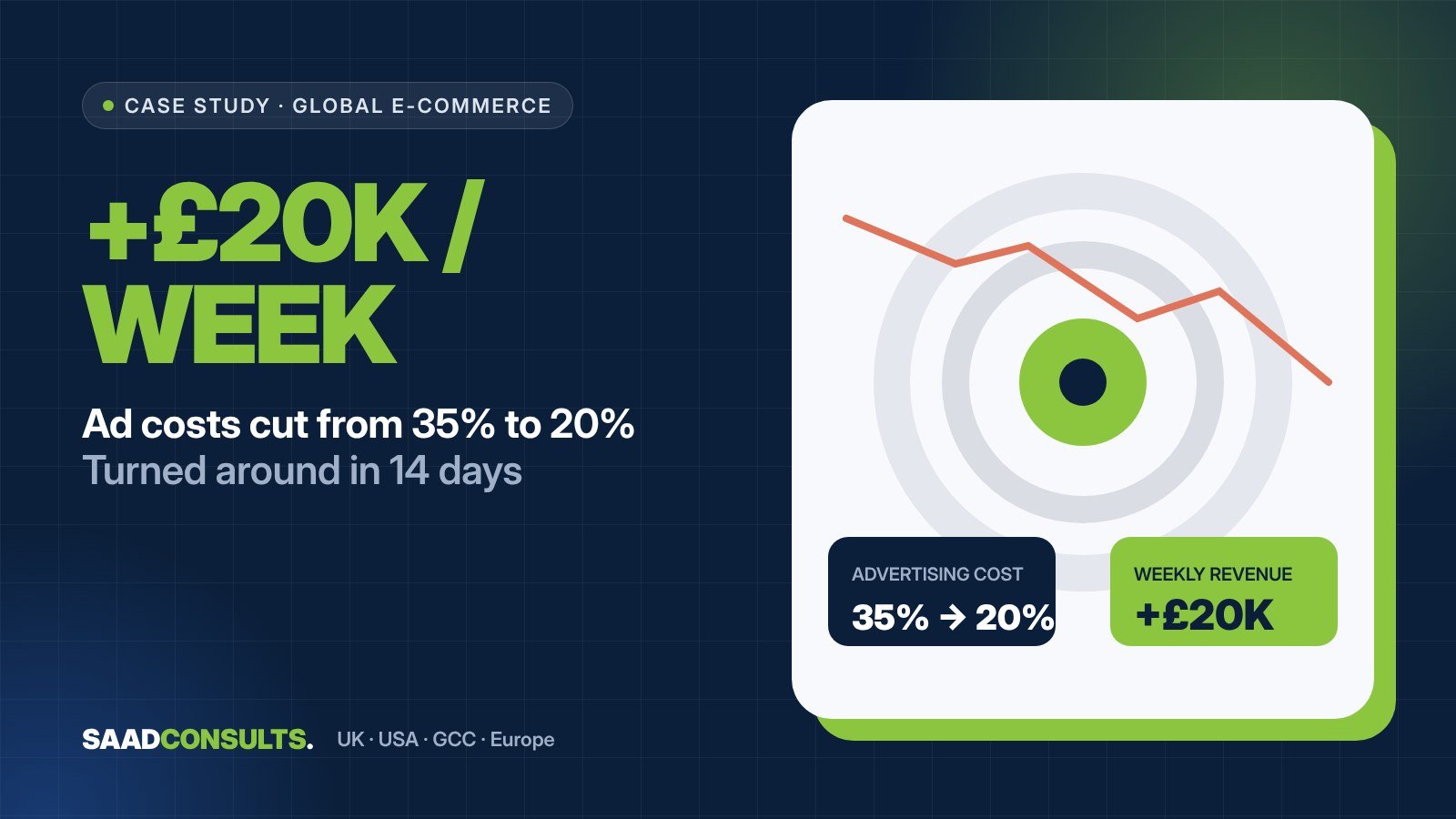
The foundation is the Merchant Center feed: German titles written the way people search, correct gross prices, shipping costs and availability. On top of that, Performance Max works best when you split products by margin, not just by category. That is exactly what I did for an international combat sports brand selling across the UK, Europe, the Gulf, the USA, Central Asia and Scandinavia. Its advertising cost of sale was 35%, above the 22% its margin could carry. I split the catalogue into three tiers: aggressive bidding for the best sellers, efficiency for the middle, minimal spend for weak products. New structures were live by day three. Within 14 days the cost of sale fell to 25%, and it averaged 20% for the rest of the year. The full story is in the combat sports e-commerce case study.
There is a European lesson in that case too. After a site migration, the brand’s language versions had started competing with the main domain. If you sell in Germany, Austria and Switzerland from one shop, check your hreflang and country setup before you blame the ads. Fixing it helped organic search grow from 20% to 35% of traffic.
When should LinkedIn and Microsoft Ads run alongside Google?
LinkedIn earns its place when your buyers are a defined group of roles, say heads of production in companies with 50 to 500 employees, and your offer needs explaining. Use it to put case studies and whitepapers in front of the buying committee, then let Google Search catch them when they start comparing suppliers. In that same e-commerce role, dedicated B2B campaigns brought in more than 20,000 vendor and wholesale leads over six months, alongside the consumer sales, which shows how differently business buyers need to be addressed.
Microsoft Advertising is the cheap second step. With Bing at about 6.5% of German searches (StatCounter), it’s small, but you can import proven Google Search campaigns in an afternoon. Many office computers default to Bing, which can matter for B2B.
What are the most common Google Ads mistakes businesses make in Germany?
I audit a lot of accounts. These six mistakes cause most of the waste I find in German accounts, and none of them depends on budget size.
Why does Google Ads show so few conversions since we added a cookie banner?
Usually because the banner blocks the Google tag completely and no consent signals are sent, or because the tag fires before consent and the setup is both non-compliant and unreliable. Either way, Smart Bidding learns from a tiny, skewed sample and your budget follows the wrong signals.
Fix: implement Consent Mode v2 through a certified CMP, test it in Tag Assistant, compare Google’s numbers with your CRM or shop every month, and import offline conversions.Why are my Google Ads getting clicks from job seekers and students?
Broad match without negatives. “Industriereinigung” brings in searches for “Industriereinigung Jobs”, “Ausbildung” and “Gehalt”. “Google Ads Betreuung” can bring in people looking for a free course. Each click costs money and none of them will buy.
Fix: build German negative lists from day one (Jobs, Stellenangebote, Ausbildung, Gehalt, kostenlos, gebraucht, PDF, Muster), review the search terms report weekly and use phrase or exact match until you have data.Is a translated English landing page good enough for German ads?
Rarely. Machine-translated copy, prices without VAT, no Impressum link and a US-style “Book a demo” button all signal “not for me” to a German buyer. Some of those also create legal risk under the DDG, PAngV and UWG.
Fix: one page per campaign theme, written by a native German copywriter in the right tone (Sie for most B2B), with Impressum, privacy notice, gross prices for consumers and a named contact.Why are my ads showing in Austria and Switzerland when I only sell in Germany?
Google’s default location option targets people “in or regularly in, or who’ve shown interest in” your locations. German-language searches from Vienna or Zurich can trigger your ads, and you pay for buyers you can’t serve.
Fix: set location options to “Presence: people in or regularly in your included locations”, and run separate campaigns with their own budgets if you do sell across DACH.Can Performance Max run the account on autopilot?
With thin consent-limited data, Performance Max chases what is easiest to win: your own brand searches, returning customers and cheap low-value orders. The dashboard looks good while new revenue stays flat.
Fix: add brand exclusions, split products or services by margin into separate asset groups or campaigns, and only launch it once Search and tracking are proven.Is a cheap Google Ads Betreuung a false economy?
Often. A low monthly fee looks like a saving until you see how much budget went to the wrong searches or was measured wrongly. The cheapest management is the one that wastes the least of your ad spend, not the one with the smallest invoice.
Fix: judge any Agentur, freelancer or consultant on cost per qualified lead or cost of sale, on the tracking they build, and on whether you own the account.What does Google Ads management in Germany include, and how do you measure ROI?
Good management is 20% setup and 80% ongoing decisions. In Germany the setup share is a little heavier, because consent, legal pages and CRM imports have to be right before scaling makes sense. Here is how the first 90 days usually run in accounts I take over.
Google Ads Agentur, freelancer or consultant: who should run your account?
Each option can work. What matters is who actually makes the decisions in your account every week.
| Option | Pros | Cons | Best for |
|---|---|---|---|
| In-house | Knows the product and the sales team | Sees one account; consent and tracking often outside their skills | Larger firms with a marketing team |
| Freelancer | Flexible, often affordable | Quality varies; execution without strategy or tracking | Simple accounts with clear goals |
| Google Ads Agentur | A team and processes | Seniors sell, juniors manage; long notice periods | Brands needing many channels and lots of creative |
| Senior consultant | Senior judgement on your account; strategy, tracking and execution joined up | Limited capacity; not the cheapest hourly rate | Firms that need ROI, a turnaround or a second opinion |
Whichever you choose, insist on three things: you own the account, you see the real numbers next to your CRM, and you get a written plan for the next 90 days.
Which KPIs show whether your Google Ads make money?
Clicks and click-through rate are diagnostics. They tell you why something happens. Whether Google Ads works is shown further down the funnel:
- Cost per qualified lead for B2B and services: ask your sales team weekly which enquiries were real.
- ROAS or advertising cost of sale (ACOS) for shops. They are two sides of the same number: 20% ACOS is a 5x ROAS.
- Lead-to-order rate from your CRM, which tells you whether the ads bring the right companies.
- Measured vs real conversions, a German-specific check that shows how much consent is costing your data.
How do you calculate ROAS and ROI for Google Ads?
ROAS = revenue from ads ÷ ad spend. If €10,000 of ads brings €45,000 in sales, your ROAS is 4.5.
ROI = (profit from ads − total cost) ÷ total cost. ROI includes product margin and management fees, so it decides whether you’re making money. A 4.5 ROAS on a 15% margin product can still lose money; a 2.5 ROAS on a 70% margin service can be very profitable. That is why I start from the margin. For the combat sports brand, the target was a cost of sale of 22% because that was where the margin stopped working. We beat it and held 20% across the year.
How SaadConsults manages Google Ads for businesses in Germany
You now know more about Google Ads in Germany than many people who sell it. It’s an auction that rewards relevance. Consent decides what Google can learn. Search usually comes first, Shopping needs a clean feed, LinkedIn reaches the buying committee, and the costliest mistakes are invisible on a dashboard. The real question is whether you want to learn this over six months with your own budget, or have someone who has already made these mistakes on other accounts fix them in the first 30 days.
I’m Saad. Since 2010 I’ve managed more than $200 million in ad spend across 30,000+ campaigns for 600+ clients in 26 industries. I led e-commerce and digital growth for the international combat sports brand above, selling across Europe while staying compliant with European privacy rules, and today I lead marketing for a group of seven luxury home improvement brands in the UAE, where a rebuilt Dubai account went to 3.3x ROAS on the same budget. I work with businesses in Germany remotely, with calls in your business hours. Campaigns and pages are written in German by native copywriters; strategy calls are in English. You work with me directly, not with a junior account manager.
What you get in a free Google Ads audit
- A review of your account structure and wasted spend
- A Consent Mode v2 and conversion tracking check: are you measuring the right things, and how much are you missing?
- Search terms you’re paying for that will never convert, including German compound-word gaps
- Landing page issues: forms, speed, Impressum and price display
- Location, language and DACH settings
- A clear 30-day action plan you can use with or without me
Industries I already know well
E-commerce, sports brands, tech and SaaS, logistics, home improvement, healthcare, luxury brands and more industries.
No pitch, no lock-in contract, and you keep ownership of your account. If I don’t think I can improve your results, I’ll say so. Request your free Google Ads audit, see how I work on the Google Ads management page for Germany, get in touch or message me on WhatsApp at +92 333 1414145.
Frequently asked questions
How much does Google Ads cost per month in Germany?
There is no fixed price. You set your own budget in euros and pay per click through an auction. Work out the budget from the leads or sales you need multiplied by your expected cost per lead, using Keyword Planner forecasts and a four to six week test to replace guesses with real numbers.
Is Consent Mode v2 mandatory for Google Ads in Germany?
Google requires advertisers to collect consent from users in the EEA and pass consent signals to Google. Without them you lose audience and personalisation features and much of your measurement. Consent Mode v2 is the standard way to send those signals.
Can I run Google Ads in German if my team doesn’t speak German?
Yes, as long as the ads and landing pages are written by native German speakers. Strategy and reporting can happen in English, but the copy your buyers see has to read naturally in German.
Do my Google Ads need to show prices including VAT?
If you advertise prices to consumers in Germany, the Price Indication Ordinance requires the total price, including VAT. Your Shopping feed prices must also match what the shop shows. B2B offers aimed only at businesses can work with net prices, but make that clear.
How long does it take for Google Ads to work in Germany?
Search ads can bring enquiries within days, but stable, profitable results usually take 30 to 90 days. B2B sales cycles are longer, so judge lead quality early and revenue later.
Should a German B2B company use LinkedIn Ads instead of Google Ads?
Usually alongside, not instead. Google Search captures companies already looking for a supplier, while LinkedIn reaches decision-makers by role and company size before they search.
Who owns the Google Ads account if I hire an agency or consultant?
You should. Insist that the account sits under your own company’s Google account with admin access for you. With me, clients keep full ownership of their accounts, data and assets.
Sources
- StatCounter, search engine market share in Germany (September 2026): Google 87.8%, Bing about 6.5%
- DataReportal, Digital 2026: Germany: internet users, mobile connections, YouTube and LinkedIn reach
- IfM Bonn via idw, July 2026: SME share of companies and employees
- LocaliQ, search advertising benchmarks 2026: mainly US industry benchmarks
- Google Ads Help, EEA privacy and regulatory changes: EU user consent policy and March 2024 audience changes
- Google for Developers, consent mode overview: consent signals, basic and advanced mode
- § 25 TDDDG: consent for storage and access on end devices
- § 5 DDG: Impressum requirements
- Steuertipps: DDG in force since 14 May 2024
- § 3 PAngV: total price duty when advertising prices to consumers
- § 5a UWG: misleading by omission
- bevh press release, January 2026: German online goods revenue 2025
- Client results are from Saad’s own projects; client names are withheld for confidentiality.

Saad is a digital marketing consultant and business growth strategist with 13+ years of experience, $200M+ in managed ad spend and 600+ clients worldwide. LinkedIn & profile →