In September 2026, Google handled 91.4% of all searches in the United Kingdom, with Bing on about 6.1% (StatCounter). The UK had around 68.1 million internet users at the end of 2025, about 97.8% of the population (DataReportal). In other words, almost everyone in the country is online, and almost everyone who searches uses Google. Whether you sell boxing gloves from a warehouse in the Midlands, conveyancing in Leeds or software to finance teams in London, your next customer is typing it into Google today.
So why do so many UK business owners tell me PPC “stopped working”?
A typical first call goes like this. It is October, an online retailer shares their screen, and the Performance Max campaign shows a return on ad spend that looks excellent. Then we open the search terms and the product report. A large share of the conversions are people who typed the brand’s own name, and most of the spend sits on two products with the thinnest margin in the catalogue. Black Friday is five weeks away and the plan is to “turn the budget up”. Google Ads isn’t the problem there. The way the account is being run is.
That is what this guide is about. I’ll walk you through how PPC management works in the UK in 2026: what it really costs in pounds, which campaign types suit which business, the consent and advertising rules that affect your ads, the mistakes I see most often, and how to tell whether your account is making money. Think of it as the first meeting I’d have with you, before any proposal is on the table.
Key takeaways
- Google Ads captures demand that already exists. In a market where nearly everyone is online and comparing prices, being visible at the moment of search is what wins the sale.
- There is no reliable UK-wide price list for clicks. Your cost comes from the auction, so estimate it from Keyword Planner and a test budget, not from a blog table.
- Under PECR, ad tracking cookies need consent. Set up a proper consent banner and consent mode before you judge any campaign on its conversion numbers.
- Your ads and landing pages fall under the ASA and the CAP Code. “Was” prices and “up to 50% off” claims need evidence, especially around Black Friday.
- Judge the account on profit: cost per qualified lead, ROAS or advertising cost of sale against your margin, not clicks.
Is Google Ads worth it for UK businesses in 2026?
Yes, for any business whose customers search before they buy. In the UK that covers e-commerce, professional services, trades, healthcare and private clinics, education, B2B suppliers, travel and financial products. The reason is intent. Someone searching “emergency plumber near me”, “boxing gloves uk” or “conveyancing solicitors leeds” has already decided they need something. Your ad appears at the moment they decide who to buy from.
Who is searching on Google in the UK right now?
Practically everyone. According to DataReportal’s Digital 2026 UK report, the country had about 68.1 million internet users and 99.3 million cellular connections in late 2025. YouTube’s advertising reach was around 55.5 million people, and LinkedIn reported about 48 million UK members (registered members, not monthly active users).
What makes the UK different is not how many people are online. It’s how they buy. In my experience UK customers compare carefully, read reviews, check delivery costs and return policies, and often come back two or three times before they order. Three groups matter most for advertisers:
- Comparison shoppers who search a product, open several tabs and buy from whoever is clearest on price, delivery and trust. Shopping ads and strong product pages win here.
- Local service buyers searching with “near me” or a town name: dentists, solicitors, electricians, driving schools. Location targeting, call tracking and reviews decide these.
- B2B buyers researching software, suppliers and agencies. They search repeatedly, check LinkedIn profiles and rarely convert on the first visit.
Google Ads vs Meta vs LinkedIn: which brings better leads in the UK?
They do different jobs. Google Search captures people who already want what you sell. Meta (Facebook and Instagram) reaches people before they search, which suits new products and visual offers. LinkedIn matters more in the UK than in many markets I work in, because so many B2B buyers are on it, but its clicks are usually the most expensive of the three.
| Factor | Google Ads (Search & Shopping) | Meta ads (Facebook & Instagram) | LinkedIn ads |
|---|---|---|---|
| Buyer intent | High: the person is actively searching | Low to medium: you interrupt their scroll | Low to medium: professional context |
| Best for | E-commerce, services, urgent needs, B2B searches | New products, fashion, food, events, retargeting | B2B targeting by job title, company and sector |
| Cost per click | Medium to high in competitive niches | Usually lower | Usually the highest |
| Lead quality | Usually higher | Mixed; needs qualifying questions | Good fit, low volume |
| Typical role | Capture demand and close | Create demand and retarget | Reach decision-makers before they search |
In my accounts the strongest results come from running Google to catch buyers who are ready, and Facebook and Instagram ads to build demand and bring back visitors who didn’t buy. If you can only afford one and people already search for your product, start with Google. Microsoft Advertising is worth a test once Google is profitable: with roughly 6% of UK searches on Bing, it is a small but often cheaper extra slice of the same demand.
How much does Google Ads cost in the UK?
Google Ads is an auction, run again for every single search. You never pay a fixed price per click. You pay just enough to beat the advertiser ranked below you, and that depends on their bids, your bid and the quality of your ad. One UK-specific line on your invoice is worth knowing about: since 1 November 2020 Google has added a 2% UK DST fee to ads served in the UK, to cover the Digital Services Tax (Google Ads Help). Build it into your budget maths.
How the Google Ads auction decides your cost per click
Every time someone searches, Google decides which ads to show and in what order using Ad Rank. Ad Rank combines your bid with your Quality Score: how relevant your ad is to the search, how likely people are to click it, and how good your landing page experience is. A well-built account with high Quality Scores can rank above a competitor while paying less per click.
That is why two firms in the same city can pay very different amounts for the same keyword. One solicitor sends “no win no fee solicitors manchester” to a page about exactly that service, with fees, reviews and a callback form. The other sends every search to a homepage listing twelve practice areas. Google rewards the first and taxes the second.
What do Google Ads benchmarks say, and do they apply to the UK?
Be careful with any “average UK cost per click” you read online. Even a UK agency that compiles PPC cost ranges says plainly that no primary UK-wide survey of Google Ads click costs exists, so its figures are a guide rather than a market statistic (Whito). I agree with that. I’d rather show you a large, clearly labelled dataset and explain how to read it than give you a UK number nobody can trace.
The most widely used benchmark set comes from LocaliQ, a US company, based on thousands of its customers’ campaigns. Treat it as a US-weighted reference in US dollars, useful for comparing industries, not as UK prices.
| Benchmark (Search ads, 2026, USD) | All industries | Shopping, collectibles & gifts | Sports & recreation | Finance & insurance | Legal services |
|---|---|---|---|---|---|
| Average cost per click | $5.42 | $4.14 | $2.77 | $3.39 | $9.87 |
| Click-through rate | 6.64% | 8.28% | 8.75% | 9.83% | 5.87% |
| Conversion rate | 8.18% | 4.01% | 7.69% | 2.64% | 5.55% |
| Cost per lead | $66.69 | $49.40 | $44.26 | $74.44 | $131.63 |
Source: LocaliQ search advertising benchmarks (updated June 2026). US-based provider; figures are in US dollars and are not UK prices.
The useful lesson in that table isn’t the dollar figures. Look at finance and insurance: one of the highest click-through rates and one of the lowest conversion rates. People click to compare, then leave. In niches like that, your landing page, your trust signals and your follow-up decide your profit, not the click price.
How much budget do you need to start PPC in the UK?
Work backwards from the result you need, not forwards from a round number. The formula I use with clients is:
Monthly budget = target leads (or sales) per month × expected cost per lead (or sale)
To get a UK estimate you can trust, use your own market’s data rather than someone else’s average:
- Put your real keywords into Google’s Keyword Planner, targeted to your UK regions, and note the top-of-page bid range in GBP.
- Assume a cautious landing page conversion rate for a new page, then calculate the cost per lead that implies.
- Run a 4 to 6 week test budget on your highest-intent keywords only, with tracking working, and replace your assumptions with real numbers.
A practical rule: give a new account enough budget to collect about 30 conversions a month. Below that, automated bidding has too little data to learn from, and every decision becomes a guess.
Which Google Ads campaign types work best for UK businesses?
Google offers seven main campaign types, and choosing the wrong one is one of the fastest ways to burn a budget. Here is how they compare in a UK context.
| Campaign type | Where ads show | Best for in the UK | Watch out for |
|---|---|---|---|
| Search | Google search results | Professional services, trades, B2B, high-intent sales | Limited by search volume; needs negative keywords |
| Shopping | Product listings with image, price and delivery | Online shops competing on price and delivery | Needs a clean Merchant Center feed with GBP prices |
| Performance Max | Search, Shopping, YouTube, Display, Gmail, Maps, Discover | E-commerce and lead gen with solid conversion data | Little transparency; can take credit for brand searches |
| YouTube / Video | YouTube and video partners | Explaining products, retargeting, brand lift | Rarely closes sales alone |
| Demand Gen | YouTube Shorts, Discover, Gmail | Visual products before peak season | Needs strong images and video |
| Display | Websites and apps | Retargeting, diaspora and awareness campaigns | Low-quality placements and accidental clicks |
| App | Play Store, search, YouTube | App installs and in-app actions | Optimise for actions, not just installs |
Shopping and Performance Max for UK e-commerce: how to make them profitable
For an online shop, Shopping is where most of the money is made or lost. The shopper sees your product, price and delivery before they click, so the click is already qualified. Performance Max then extends that feed across YouTube, Display and Gmail. The problem is that Performance Max, left alone, spends where conversions are easiest to get, not where profit is highest.
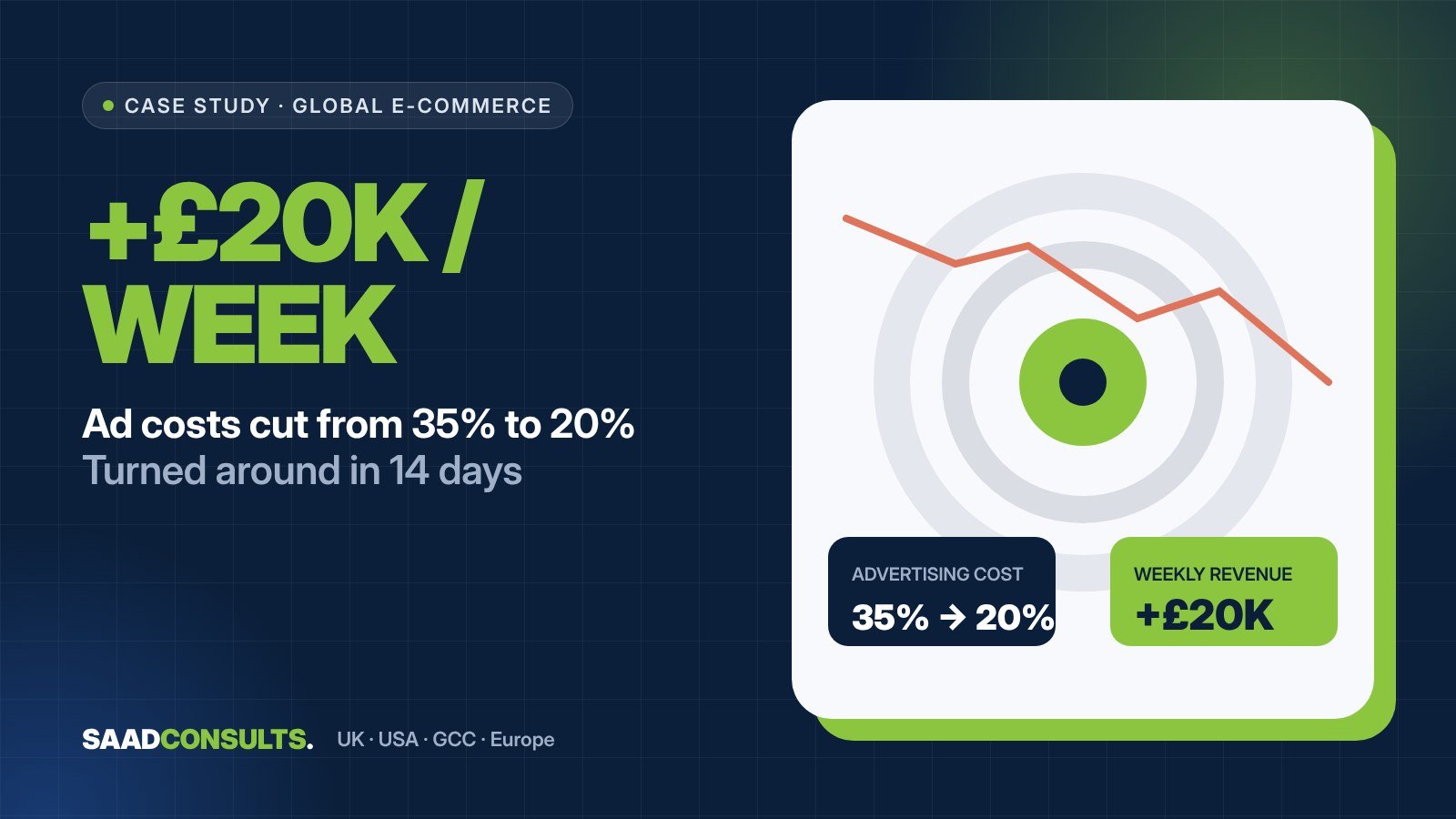
I saw this first-hand as Head of E-commerce and Digital Growth for an international combat sports brand selling across the UK, Europe and other regions. Performance Max and Meta conversion campaigns were chasing cheap clicks instead of high-value buyers. For every pound of revenue, 35 pence was going back into advertising, while the margin only worked at 22 pence or less. I split the catalogue into three tiers: top performers got aggressive bidding, mid-tier products ran for efficiency, and weak sellers dropped to minimal spend. New campaign structures were live by day three. The full story is in the combat sports e-commerce case study.
The practical rules I took from that account and apply to every UK shop:
- Tier your products by margin and performance, with separate campaigns or asset groups and different targets for each tier.
- Exclude your brand terms from Performance Max, or at least report on them separately, so it can’t take credit for customers who were already coming.
- Keep the feed honest: correct GBP prices, delivery costs, stock and sale prices. If stock runs out, the ads must stop pushing it.
Search vs Performance Max: which should you run first?
For service businesses and B2B, Search first. Search gives you control: you choose the keywords, read the actual search terms, block irrelevant ones and write ads for each intent. It also builds the conversion data automation needs. For an established online shop with a clean feed and reliable tracking, Shopping or a carefully structured Performance Max campaign can run from the start, as long as brand traffic is separated and product tiers are in place.
How should you plan Google Ads for Black Friday and Christmas in the UK?
The peak is bigger than one weekend. Adobe reported that UK shoppers spent about £26.9 billion online in November and December 2025, with £1.16 billion on Black Friday alone, £3.8 billion across Cyber Weekend, and mobile accounting for 61.5% of the period’s online spend (IT Brief, reporting Adobe Digital Insights). In 2026 Black Friday falls on 27 November and Cyber Monday on 30 November.
Three things I check with every UK retailer before the peak. First, that tracking and consent are working, because you can’t fix them in the middle of Cyber Weekend. Second, that every “was” price and “up to” claim can be backed up, which I cover in the next section. Third, that budgets rise before demand does, not after, so the bidding has time to adjust.
Your free marketing strategy starts with your numbers
Move the sliders to see what your budget could return. Then get a free strategy built for your business: the right platforms, your budget split and your first 30 days.
Estimates based on Saad's campaign benchmarks across 26 niches. Not a guarantee. Your free strategy gives you a real plan.
Create your free strategy
- The right platforms, and what to post
- Your paid ads plan and budget split
- Your first 30 days, week by week
Want more? Stage 2 Advanced Strategy, GBP 16 or hire me and my team for 100% digital coverage.
What does professional PPC management include in the UK?
Good management is 20% setup and 80% ongoing decisions. In the UK it also includes two jobs that many accounts skip: consent-aware tracking and compliant ad claims.
| Area | What it involves | How often |
|---|---|---|
| Account audit & structure | Campaigns grouped by intent, product tier and region; no overlap | At the start, then quarterly |
| Consent & conversion tracking | Consent banner, consent mode, GA4, Tag Manager, enhanced conversions, call tracking, CRM imports | At the start, then checked weekly |
| Keywords & negatives | Adding winning searches, blocking irrelevant ones | Weekly |
| Ads, assets & claims | Testing headlines and offers; checking every price and saving claim can be substantiated | Every 2 to 4 weeks |
| Feed & Shopping | Titles, GBP prices, delivery, stock, product tiers | Weekly, daily in peak |
| Landing pages | One focused page per campaign theme; speed, forms, clear total price | Monthly |
| Reporting | Leads, sales, cost of sale and ROAS in plain English | Monthly, with weekly checks |
Consent mode, UK GDPR and PECR: what does the ICO expect from advertisers?
This is the part most UK accounts get half right. The ICO’s guidance is clear: if your site uses cookies or similar technologies for online advertising, you must get consent, and none of the exceptions apply (ICO). Measuring those ads, such as conversion tracking, falls under that same advertising consent rather than needing a separate one.
The Data (Use and Access) Act 2025 did relax some rules. It allows certain cookies, such as those used purely for statistical purposes, without consent, and the ICO says all its data protection provisions were in force by June 2026 (ICO). But the ICO’s guidance on exceptions is explicit that the statistical exception does not cover advertising, and that you must still give people clear information and a simple way to object (ICO).
Google’s own EU user consent policy also applies to users in the UK, and requires consent for cookies where legally required and before its advertising tags fire. Google says it does not expect a verified consent signal for UK traffic in the way it does for the EEA (Google). In practice I still set up consent mode for UK sites, because it is the cleanest way to respect people’s choices and keep Google’s conversion modelling working when people decline. What that means for you:
- Your reported conversions will be lower than your real sales, because some people say no. Compare Google’s numbers with your shop or CRM, never in isolation.
- A banner that only has “Accept” is not consent. Give an equally easy way to reject.
- Import offline sales or qualified leads from your CRM where you can, so bidding learns from real outcomes.
ASA and CAP Code: what rules apply to your Google ad claims?
Paid-for search listings and claims on your own website are both within the ASA’s remit (ASA). That means your headlines, sitelinks, price extensions and landing pages must follow the CAP Code. Two rules catch advertisers most often. You must hold evidence for objective claims before the ad runs (rule 3.7), and you must not leave out material information (rule 3.3) (ASA).
For sales and Black Friday, the ASA’s guidance on savings claims says a “was” price must be a genuine, established usual selling price, and advertisers should be able to show at least three months of pricing history. For “up to” claims, a significant proportion of the range should actually carry the maximum discount, and the ASA suggests less than 10% is unlikely to count (ASA).
Consumer law adds weight to this. Since April 2025, under the Digital Markets, Competition and Consumers Act, the CMA can fine businesses up to 10% of global turnover for consumer law breaches, and the regime bans drip pricing and fake reviews (GOV.UK). For your ads, that means the price in the ad should match the price people pay at checkout, with unavoidable fees included.
Agency, freelancer or consultant: how does PPC management pricing work in the UK?
I won’t quote “typical UK fees”, because published ranges are compiled from agency websites and vary too much to be useful. What I can do is explain the pricing models you’ll be offered, so you can compare like with like.
| Option | Common pricing models | Pros | Watch out for |
|---|---|---|---|
| Do it yourself | No fee; your time | You know your business | Costly trial and error; tracking and compliance gaps |
| Freelancer | Hourly or a flat monthly fee | Affordable; flexible | Quality varies; often execution only, no strategy or tracking |
| PPC agency | Monthly retainer, percentage of ad spend, or a mix; often a setup fee and a minimum term | A team, processes and cover for holidays | Senior people sell, juniors manage; a percentage fee rewards spending more, not earning more |
| Senior consultant | Monthly retainer or project fee for an audit or turnaround | Senior experience on your account; strategy, tracking and execution joined up | Limited capacity; not the cheapest hourly rate |
Whichever you pick, insist on three things: you own the Google Ads account, you see the real numbers, and the scope and notice period are written down before you start.
What are the most common Google Ads mistakes UK businesses make?
I audit a lot of accounts. The same mistakes cause most of the waste, and very few of them are about the size of the budget.
Why does my Google Ads ROAS look great but profit doesn’t?
Usually because Performance Max or broad match is being credited with people who searched your brand name and would have bought anyway, while your margin-poor products take most of the spend. The dashboard improves while the bank balance doesn’t.
Fix: separate brand from non-brand, tier products by margin, and judge results on advertising cost of sale against your real margin.Is my cookie banner breaking my conversion tracking?
Either it fires ad tags before anyone has agreed, which is a PECR problem, or it blocks everything without consent mode, so Google sees a fraction of your sales and bids blind. Both are common, and both are expensive in different ways.
Fix: use a proper consent platform with a clear reject option, set up consent mode, and reconcile Google’s conversions with your shop or CRM monthly.Can a Black Friday “was” price get my ad reported to the ASA?
Yes. Paid search ads and your website are both in scope. Inflated reference prices, “up to 70% off” when only a few items are, or prices that grow at checkout can lead to complaints, rulings and, under the newer consumer law regime, CMA action.
Fix: keep pricing history for every product you promote, sign off offer wording before November, and show the full price in the ad.Why are my Google Ads getting clicks but no enquiries?
Broad keywords with no negative list. “Accountant” brings in people searching for accountant jobs, accountant salaries and accountancy courses. “Boxing gloves” brings in people looking for cheap kids’ toys. Each click costs money and none of them will buy.
Fix: review the search terms report weekly, build negatives from day one, and use phrase or exact match until you have data.Sending every ad to the homepage
Someone searching “invisalign cost london” lands on a dental practice homepage with a slider and a list of treatments. They leave. A focused page about Invisalign with clear prices, finance options, reviews and a booking form would have kept them.
Fix: one landing page per service or campaign theme, loading quickly on mobile, with the price people will actually pay.Treating the UK as one market
A national budget with one set of ads lets London’s expensive clicks eat the budget meant for regions where you convert more cheaply. Timing matters too. When I ran a remittance campaign for a bank targeting overseas Pakistanis, UK professionals tended to send money around month-end, so UK ads were timed for that, not copied from the Gulf schedule.
Fix: split campaigns by region or audience where costs and behaviour differ, and schedule budgets around when your customers actually decide.How long does Google Ads take to work, and how do you measure ROI?
Search and Shopping campaigns can bring sales on day one. Reliable, profitable results usually take 30 to 90 days, because that is how long it takes to collect enough data, clean out wasted searches and let bidding learn. If you’re planning for Black Friday, that is exactly why the work starts in September, not in November. Here is how that period usually runs in accounts I manage.
Which KPIs matter: cost per lead, ROAS or advertising cost of sale?
Clicks, impressions and click-through rate are diagnostic numbers. They tell you why something is happening. The numbers that tell you whether Google Ads is working are further down the funnel.
- Cost per qualified lead for services, B2B and finance: what a real sales opportunity costs.
- ROAS or advertising cost of sale for e-commerce: revenue for every pound spent, or the share of revenue that goes back into ads.
- Lead-to-sale rate, always. Ask your sales team weekly whether the leads are the right people.
- Impression share, when deciding whether there is room to scale before the peak.
How do you calculate ROAS, ACOS and ROI for Google Ads?
ROAS = revenue from ads ÷ ad spend. If £10,000 of ads brings £45,000 in sales, your ROAS is 4.5.
Advertising cost of sale (ACOS) = ad spend ÷ revenue from ads. It is the inverse of ROAS: a 20% ACOS equals a 5x ROAS. UK e-commerce teams often find ACOS easier, because you can set it directly against your margin.
ROI = (profit from ads − total cost) ÷ total cost. ROI includes your product margin, delivery, returns and management fees, so it is the number that decides whether you’re really making money. A 4.5 ROAS on a product with a 15% margin can still lose money, while a 2.5 ROAS on a high-margin service can be very profitable. That is why, in the combat sports account, the target wasn’t “more ROAS”. It was an advertising cost of sale under the 22% the margin could carry.
How SaadConsults manages Google Ads for UK businesses
By now you know more about Google Ads than many people who sell it. You know it’s an auction that rewards relevance, that consent and tracking decide what Google learns, that Shopping and Performance Max need product tiers and brand separation, and that ASA rules apply to your ads as much as to a billboard. The question is whether you want to spend the next six months learning this with your own budget, ideally not during your peak season, or have someone fix it in the first 30 days.
I’m Saad. Since 2010 I’ve managed more than $200 million in ad spend across 30,000+ campaigns for 600+ clients in 26 industries. I work remotely with UK businesses, with calls in UK hours and proposals in GBP. For an international combat sports brand I cut advertising cost of sale from 35% to 20% and added about £20,000 a week. I’ve also run diaspora campaigns aimed at British Pakistanis, including the bank remittance campaign across the UK, the USA and the Gulf. You work with me directly, not with a junior account manager.
What you get in a free Google Ads audit
- A review of your account structure and wasted spend
- A check of your consent setup and conversion tracking: is it counting the right things, legally?
- Brand traffic and margin-poor products hiding inside Performance Max
- Search terms you’re paying for that will never convert
- Ad and landing page claims that could cause ASA problems
- A clear 30-day action plan you can use with or without me
Industries I already know well
E-commerce, sports brands, banks and financial services, healthcare, education, home improvement, law firms and many more industries.
No pitch, no lock-in contract, and you keep ownership of your account. If I don’t think I can improve your results, I’ll tell you. Request your free Google Ads audit, see how I work on the Google Ads management page, get in touch, or message me on WhatsApp at +92 333 1414145.
Frequently asked questions
How much does Google Ads cost per month in the UK?
There is no fixed price. You set your own budget and pay per click through an auction, plus Google’s 2% UK DST fee. Work out your budget from the leads or sales you need multiplied by your expected cost per lead, using Keyword Planner and a short test campaign to estimate UK costs. Aim for enough budget to reach about 30 conversions a month so automated bidding can learn.
Why is there an extra 2% on my UK Google Ads invoice?
Since 1 November 2020, Google has added a 2% UK DST fee to invoices for ads served in the UK, to cover the UK Digital Services Tax. It is charged on top of your ad spend, so include it when you calculate cost per lead and ROAS.
Do I need cookie consent to track Google Ads conversions in the UK?
Yes. The ICO says cookies and similar technologies used for online advertising need consent, and measuring those ads falls under that advertising consent. The newer exception for statistical cookies does not cover advertising. Use a consent banner with a clear reject option and set up consent mode.
Is Microsoft Advertising worth running alongside Google in the UK?
Often, once Google is profitable. Bing had about 6% of UK searches in September 2026, according to StatCounter. That is a small extra audience, but you can import your Google campaigns and test it with a modest budget.
Should my online shop use Performance Max or standard Shopping?
Both can work. Performance Max reaches more channels, but it needs reliable tracking, product tiers by margin and brand traffic separated, or it will chase the easiest conversions. Standard Shopping gives more control and is a sensible start for a new or small catalogue.
Can someone complain to the ASA about a Google ad?
Yes. The ASA covers paid-for search listings and claims on your own website. Price claims, savings claims and other objective claims need evidence before the ad runs, and important information such as the full price must not be left out.
Who owns the Google Ads account if I hire a PPC agency?
You should. Insist the account sits under your own business’s Google login with admin access for you, so the history and data stay with you if you change provider. With me, clients keep full ownership of their accounts, data and assets.
How soon will I see results from Google Ads?
Search and Shopping ads can bring sales within days, but stable, profitable results usually take 30 to 90 days while the account collects data, removes wasted searches and lets bidding learn. For a peak season like Black Friday, start preparing in September.
Sources
- StatCounter, search engine market share in the United Kingdom (September 2026)
- DataReportal, Digital 2026: The United Kingdom
- Google Ads Help, jurisdiction-specific surcharges (2% UK DST fee)
- LocaliQ, search advertising benchmarks (US-based, USD)
- Whito, UK PPC costs (note on the lack of a primary UK-wide survey)
- IT Brief UK, reporting Adobe Digital Insights on UK online holiday spend 2025
- ICO, how the rules apply to online advertising
- ICO, storage and access technologies: what are the exceptions?
- ICO, the Data (Use and Access) Act 2025: what it means for organisations
- Google, help with the EU user consent policy (EEA, UK and Switzerland)
- ASA, what we cover (paid-for search listings)
- ASA, misleading advertising (CAP Code rules 3.3 and 3.7)
- ASA, promotional savings claims
- GOV.UK / CMA, new consumer protection regime comes into force (April 2025)
Client results are from Saad’s own projects; client names are withheld for confidentiality.

Saad is a digital marketing consultant and business growth strategist with 13+ years of experience, $200M+ in managed ad spend and 600+ clients worldwide. LinkedIn & profile →