Google still handled 91.4% of UK searches in September 2026, with Bing on about 6.1% (StatCounter). What people see when they search has changed, though. Ofcom found that about 30% of Google searches in the UK now show an AI Overview, and 53% of adults say they often see these summaries. In the first eight months of 2025, people in the UK visited ChatGPT about 1.8 billion times, up from 368 million in the same period of 2024 (Ofcom, Online Nation 2025).
So what does that look like inside a real business?
A typical first call goes like this. The owner of a firm of accountants shares their Search Console screen. Impressions are up on the year, clicks are down. Their best guide, on IR35 for contractors, now sits under an AI Overview that answers the question in four lines and links to two competitors. Then they type “accountant for contractors in Manchester” into ChatGPT, and their firm isn’t mentioned at all. “Has SEO stopped working?” It hasn’t. The rules about who gets seen have shifted, and most websites haven’t caught up.
This guide is the conversation I’d have with you before any proposal: how Google ranks pages now, what the work includes, how AI answers choose their sources, what it costs in pounds, how long it takes and how to measure it.
Key takeaways
- AI search doesn’t replace SEO. Google says there are no extra requirements to appear in AI Overviews or AI Mode.
- Fewer people click when an AI summary appears, so aim to be the cited, trusted source and grow the pages closest to a sale.
- Local firms win through Google Business Profile and genuine reviews. Fake reviews are banned under UK consumer law.
- Published UK SEO prices run from under £100 to over £5,000 a month, so compare scope, not price tags.
- Judge SEO on enquiries, sales and organic share of revenue, not on screenshots of rankings.
How does Google rank websites in the UK in 2026?
The basics haven’t moved as much as the headlines suggest. What has changed is the results page itself, and how often the person reading it ever reaches your site.
What are the main ranking factors that still matter?
I group them into four questions, because that is how I audit a site:
- Can Google reach it? Crawling, indexing, redirects, site speed and mobile rendering.
- Does it match the search? A page built for “boiler installation cost uk” should show prices, not a company history.
- Is it the most helpful answer? First-hand detail, clear structure, real prices, named authors and recent updates.
- Do other people vouch for you? Links, press mentions, reviews and a consistent business identity across the web.
Ofcom reports that 82% of UK adults use Google Search, so these four questions still decide most of your visibility. An AI layer now sits on top of them.
How have AI Overviews and AI Mode changed Google search in the UK?
AI Overviews summarise an answer at the top of many results pages, with a few supporting links. AI Mode, which began rolling out in the UK on 28 July 2025, is a separate tab for longer questions. It breaks a question into subtopics and runs many searches at once, a method Google calls “query fan-out” (Google). In July 2026 Google said AI Mode had passed 1 billion monthly active users worldwide, and the Gemini app had 950 million (Google, Q2 2026 earnings remarks).
Query fan-out is the part that matters for your website. Ask “best way to fund a loft conversion in Bristol” and Google may look for pages on costs, planning permission, finance and local builders, then stitch the answer together. A page that answers one of those sub-questions clearly can be cited without ranking first for the whole question.
Is SEO still worth it if AI answers mean fewer clicks?
Yes, but be honest about the maths. Pew Research tracked the browsing of 900 US adults and found that people clicked a normal result on 8% of visits when an AI summary appeared, against about 15% when it didn’t. Only around 1% clicked a link inside the summary itself (Pew Research Center).
Informational traffic (“what is”, “how does”) is shrinking. Commercial searches such as “divorce solicitor glasgow”, “boxing gloves 16oz uk” or “emergency electrician near me” still send people to websites, because they need to compare, book or buy. So put most of the effort into the pages close to a sale, and make your expert content good enough to be the source the AI quotes.
What do SEO services include for a UK business?
SEO isn’t one job. It is five kinds of work, and most sites need some more than others. Here is how they compare.
| Type of work | What it involves | Who needs it most in the UK | Typical sign it’s missing |
|---|---|---|---|
| Technical SEO | Crawling, indexing, speed, redirects, canonicals, hreflang, structured data | Online shops, large sites, sites after a migration or redesign | Pages “discovered, not indexed”; traffic drops after a relaunch |
| Keywords and content | Service, category and product pages, guides, comparison and pricing pages | Professional services, B2B, clinics, education | Impressions with few clicks; pages stuck on page two |
| Links and digital PR | Earning mentions and links from relevant, trusted UK sites and media | Competitive national markets, new brands | Good pages that still can’t outrank older competitors |
| Local SEO | Google Business Profile, reviews, location pages, consistent details | Trades, clinics, solicitors, restaurants, multi-branch firms | Missing from the map pack for “near me” and town searches |
| AI search visibility | Clear answers, consistent business facts, crawler access, tracking AI mentions | Anyone whose buyers research before getting in touch | Competitors named in ChatGPT or AI Overviews, you aren’t |
Technical SEO: what should a UK site audit check first?
Whether Google can find, render and index the pages that make you money. The UK problems I see most are a Shopify or WordPress migration that left old URLs without redirects, filter pages creating thousands of near-duplicates, and UK, EU and US versions of a site competing with each other.
I fixed that last one as Head of E-commerce and Digital Growth for an international combat sports brand selling across the UK and Europe. After a migration, the language versions of the site were competing with the main domain, so years of authority were being split into pieces. Correcting hreflang, canonicals and the URL structure let that authority flow back to one place. The full story is in the combat sports e-commerce case study.
Keyword research: how do you find the searches UK buyers actually use?
Start with the words your customers say on the phone, not the words in your brochure. UK searchers use British terms and local qualifiers, and the difference matters: “solicitor” not “attorney”, “estate agents” not “realtors”, “MOT near me”, “conveyancing quotes”, “dentist accepting NHS patients”. Then sort every phrase by intent:
- Buying searches with a service, a place or a price in them (“boiler installation cost uk”). These get your strongest pages.
- Comparison searches (“xero vs quickbooks for small business uk”). Honest comparison pages win these and are often quoted by AI.
- Question searches (“do I need planning permission for a garden room”). Useful for authority, but expect fewer clicks.
If the top ten for a phrase are all national directories, a small local firm should target the narrower phrase instead.
Content: how do you write pages that rank and get quoted by AI?
Open each important page with a direct answer, use headings that match how buyers ask, and show why you’re qualified: real price ranges, a named author and the date it was last updated.
AI systems quote pages that state facts plainly. “Most loft conversions in England don’t need planning permission if they stay within permitted development limits” is quotable. A paragraph about “transforming your living space” is not.
Links and digital PR: how do UK businesses earn links safely?
By giving journalists and relevant sites a reason to mention you: your own data (a price survey across UK cities, say), expert comment for a trade title, or genuine local involvement. Links still count. Google lists the number of websites linking to a business as part of how it judges prominence (Google Business Profile Help). Bought link packages are a shortcut to a manual action.
How do local SEO and Google Business Profile work in the UK?
For trades, clinics, solicitors, estate agents and restaurants, the map pack that appears for “near me” and town searches is usually worth more than the blue links below it.
How do you rank in the Google map pack?
Google says local results are based mainly on relevance, distance and prominence, and that there is no way to request or pay for a better local ranking (Google). You can’t move your office closer to every searcher, so you work on the other two: the right primary category, complete services and opening hours, real photos, a location page on your site for each branch, and a steady flow of genuine reviews with replies.
Are paid or incentivised Google reviews legal in the UK?
Fake ones aren’t. Since April 2025, the Digital Markets, Competition and Consumers Act has banned posting or commissioning fake reviews, and the CMA can fine a company up to 10% of its global turnover for breaching consumer protection law (GOV.UK). Ask every happy customer, make it easy with a direct link, and never write or buy reviews.
Your free marketing strategy starts with your numbers
Move the sliders to see what your budget could return. Then get a free strategy built for your business: the right platforms, your budget split and your first 30 days.
Estimates based on Saad's campaign benchmarks across 26 niches. Not a guarantee. Your free strategy gives you a real plan.
Create your free strategy
- The right platforms, and what to post
- Your paid ads plan and budget split
- Your first 30 days, week by week
Want more? Stage 2 Advanced Strategy, GBP 16 or hire me and my team for 100% digital coverage.
How do you get cited in Google AI Overviews, ChatGPT, Gemini and Perplexity?
“GEO” and “AEO” are often sold as a separate service. The useful parts are mostly good SEO done carefully, plus a few technical checks.
What does Google say about optimising for AI Overviews and AI Mode?
Google’s documentation is unusually direct. There are “no additional requirements” to appear in AI Overviews or AI Mode, and no other special optimisations needed. A page must simply be indexed and eligible to appear in Search with a snippet. You don’t need new machine-readable files or special schema markup. Traffic from these features is counted in Search Console’s Performance report under the “Web” search type, and you can limit what is shown with nosnippet, max-snippet or noindex (Google Search Central).
How do ChatGPT and Perplexity choose which sites to cite?
They search the web, read pages and cite the ones that answer clearly. The first check is access. OpenAI uses a crawler called OAI-SearchBot to surface sites in ChatGPT’s search features, and sites that block it won’t be shown in ChatGPT search answers. GPTBot is separate and relates to training, so you can allow search and block training if you prefer (OpenAI).
Usage is no longer niche. OpenAI said in February 2026 that ChatGPT had reached 900 million weekly active users (TechCrunch). For local services, BrightLocal’s 2026 survey found 45% of consumers had used ChatGPT or another AI tool for local recommendations, up from 6% a year earlier (BrightLocal). That survey is of US consumers, so read it as a direction of travel.
Beyond access, consistency works: your name, services and locations should match on your site, Business Profile, Companies House listing and LinkedIn.
| Platform | Where its sources come from | What you control |
|---|---|---|
| Google AI Overviews | Google’s index; pages eligible for a snippet | Indexing, snippet controls, content quality |
| Google AI Mode | Google’s index, through many fan-out searches | Pages that answer sub-questions clearly |
| Gemini app | Google systems; Google-Extended covers training and grounding outside Search | Google-Extended in robots.txt |
| ChatGPT search | Pages crawled by OAI-SearchBot | Allow OAI-SearchBot; GPTBot is a separate choice |
| Perplexity | Live web search with numbered source links | Crawler access, clear and corroborated pages |
What do the CMA’s new rules on Google mean for your website?
The UK now has its own rules on how Google treats websites in AI search. On 3 June 2026 the CMA imposed a publisher conduct requirement on Google: publishers must be able to opt out of their content powering AI features such as AI Overviews, content must be attributed with clear links, and publishers can opt out of fine-tuning. Google has nine months to put it in place (GOV.UK). On 17 June 2026 a fair ranking requirement followed: Google must rank organic results, including in its generative AI features, on objective and non-discriminatory criteria, give notice of material changes and let publishers raise concerns about manual actions (GOV.UK).
My advice for most businesses: don’t opt out. If you sell services or products, being cited is worth more than the content you’d protect.
One more point on AI, because clients ask it in every meeting. I use AI tools daily for outlines, drafts, schema and data checks, but they are assistants, not the strategist. Google’s spam policies name “using generative AI tools or other similar tools to generate many pages without adding value for users” as scaled content abuse (Google). Your first-hand experience and an expert deciding what to publish are what make a page worth citing.
How much do SEO services cost in the UK, and how long do they take?
There is no official price list. The most transparent dataset I’ve found comes from Whito, which collected 45 published UK SEO prices in June 2026 and is open about its limits.
What do UK SEO agencies, freelancers and consultants charge?
| Item (UK, GBP) | Published range | What it usually covers |
|---|---|---|
| All published monthly SEO prices (45 prices) | £99 to £5,000+ a month; median £799 | Anything from a basic package to a full agency retainer |
| Budget band | £99 to £300 a month | Reporting and light on-page work |
| Mainstream band | £350 to £1,000 a month | Small business retainers, some content |
| Established agency band | £1,500 to £5,000+ a month | Strategy, technical, content and links |
| One-off SEO audit (planning anchor) | £500 to £3,000 | Technical and content review with priorities |
| Local SEO setup (planning anchor) | £250 to £800 | Google Business Profile and citations |
Source: Whito, UK SEO costs (published prices collected June 2026; the audit and local setup figures are Whito’s planning anchors from Q1 2026 sources, not prices from its file).
A price is not a scope. A £400 package and a £4,000 retainer can both be called “SEO”, and a low fee with no content, fixes or links usually buys a report rather than growth. I send a written proposal in GBP after the audit, because a 20-page clinic site and a 20,000-product shop need very different work.
How long does SEO take to work in the UK?
Technical fixes can show results within weeks. New content and links take longer to be crawled, trusted and ranked. Here is how a typical first year runs.
How do you measure the ROI of SEO and AI search?
Tie the work to enquiries and revenue. Rankings and traffic tell you why something is happening, not whether it pays. The KPIs I report on for UK clients:
- Organic enquiries and sales by landing page, matched to your CRM or shop.
- Organic share of revenue: how much of your business no longer depends on paid clicks.
- Clicks on commercial queries in Search Console, kept apart from informational ones.
- Calls and direction requests from Google Business Profile for local firms.
- AI visibility: how often you are named for a fixed set of 20 to 30 buyer questions, checked monthly in each assistant.
In GA4, create a custom channel group for referrers such as chatgpt.com, perplexity.ai and gemini.google.com. Some AI visits arrive without a referrer and show as direct, so the number understates reality, which is why the monthly manual check matters.
What are the most common SEO mistakes UK businesses make?
The same mistakes cause most of the lost traffic and wasted fees I find in audits.
Why did my traffic drop after a website redesign?
Old URLs weren’t redirected, internal links broke, or content now sits behind scripts Google struggles to render. Years of rankings can vanish in a week.
Fix: map every old URL to its new one before launch, crawl the staging site, and watch Search Console’s indexing report daily for the first month.Is my security plugin blocking ChatGPT and AI crawlers?
Often, and nobody chose it. Bot protection on a CDN or plugin can block OAI-SearchBot, so your site can’t appear in ChatGPT search answers.
Fix: check robots.txt and server logs, and decide per crawler. Search and training are separate choices.Publishing hundreds of AI-written pages to rank faster
It can work for a few weeks. Then an update arrives and the whole section loses visibility, because Google treats it as scaled content abuse.
Fix: publish fewer, better pages with real prices and expert input, using AI to draft, not to decide.Can I buy Google reviews to rank higher in the map pack?
No. Fake reviews are banned under UK consumer law, Google removes them, and the CMA can fine up to 10% of global turnover.
Fix: build a review request into every completed job or order, and reply to every review, good or bad.Targeting national keywords when you serve one city
A Manchester accountant chasing “accountant” competes with national firms and directories it can’t beat, while “accountant for contractors manchester” goes to a rival with a dedicated page.
Fix: build pages around the services and places you actually serve, and match your Business Profile categories to them.Judging an SEO agency on rankings reports
A PDF showing 200 keywords “in the top 10” can hide the fact that none of them bring buyers.
Fix: agree on enquiries and organic revenue as the main measures, and keep ownership of Search Console, GA4 and your Business Profile.How SaadConsults delivers SEO services for UK businesses
You now know that AI answers are built from the same index as normal results, that clicks are falling on informational searches but not buying ones, and that UK prices cover very different work. You can spend a year and a retainer finding out which of this matters for your site, or have it diagnosed in the first month.
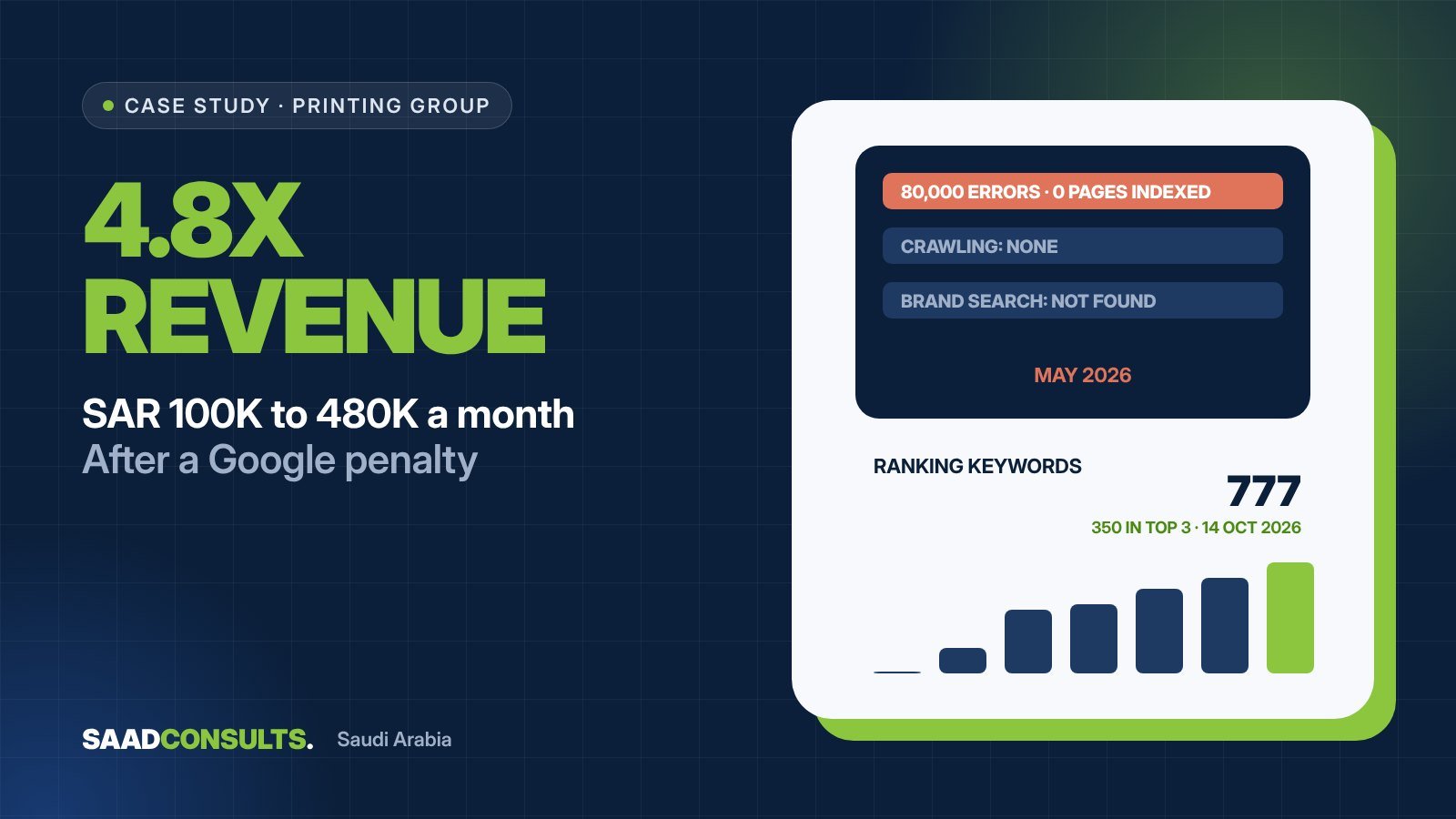
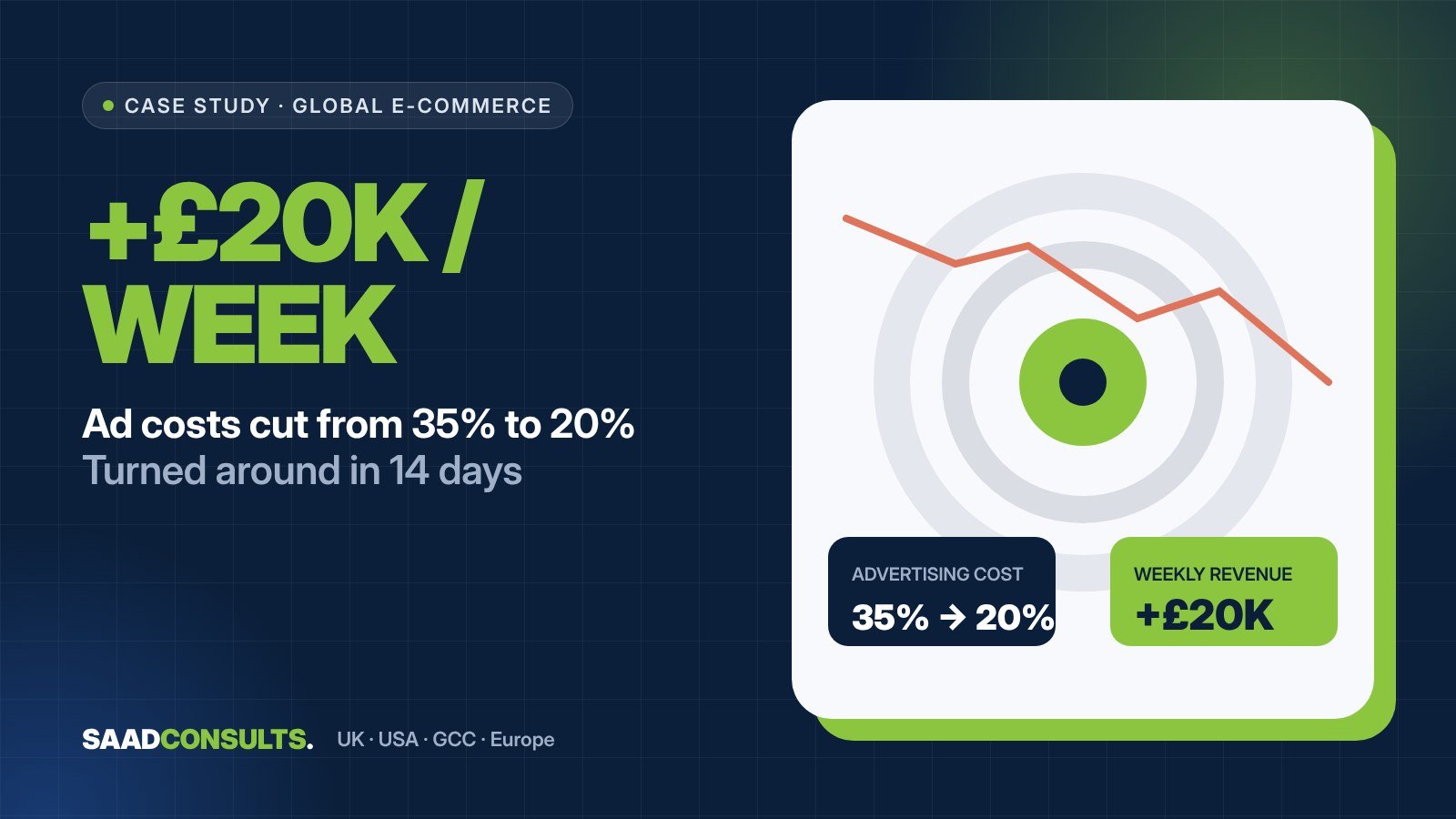
I’m Saad. I started my career in SEO in 2010, and since then I’ve managed more than $200 million in ad spend across 30,000+ campaigns for 600+ clients in 26+ industries. On the organic side I led digital marketing for a national property portal that reached 60,000+ keywords in Google’s top 10, reversed an 80% traffic crash at a large job portal in 15 days, and grew organic search from 20% to 35% of traffic for an international combat sports brand selling in the UK. I work remotely with clients worldwide, with calls in UK hours and proposals in GBP, and you deal with me directly, not with a junior account manager. More is on my about page.
How we would work together
- Meeting: a call about your business, margins, customers and goals.
- Audit: technical SEO, content, local visibility, links and AI mentions.
- Strategy: a written plan with priorities, scope and costs in GBP.
- Execution: fixes, pages and outreach, hands-on or alongside your team.
- Scaling and reporting: monthly reports on enquiries and revenue, then more of what works.
What you get in a free SEO and AI search audit
- An indexing and technical check: what Google can and can’t see on your site
- A review of your money pages against the competitors who outrank you
- Your Google Business Profile, reviews and local visibility
- Whether ChatGPT, Gemini, Perplexity and AI Overviews mention you for your buyers’ questions
- Crawler access settings and GA4 tracking for organic and AI referrals
- A clear 30-day action plan you can use with or without me
Want a senior specialist on your side rather than another agency layer? See how it works on the hire a digital marketing consultant in the UK page, or go straight to hire a digital marketer if you need someone to run SEO, content and tracking hands-on. The service itself is set out on my SEO services page.
No pitch, no lock-in contract, and you keep ownership of every account and page. If I don’t think I can improve your results, I’ll tell you. Request your free SEO audit or get in touch. In a hurry? WhatsApp me.
Frequently asked questions
Is GEO or AEO different from SEO?
Mostly not. Both describe making content easy for AI systems to find and quote, which depends on the same things as SEO: indexing, clear answers and authority. The genuinely new parts are crawler access for tools like ChatGPT and tracking how often AI answers mention you.
Do I need an llms.txt file for AI search?
Not for Google. Google’s documentation says you don’t need new machine-readable files or special markup to appear in AI Overviews or AI Mode. Having one does no harm, but it shouldn’t be sold to you as the key to AI visibility.
Can I stop Google using my content in AI Overviews?
Partly today, through snippet controls such as nosnippet and max-snippet, which also affect your normal listings. Under the CMA’s publisher conduct requirement of June 2026, Google has nine months to give publishers an effective opt-out. Most businesses that sell services or products are better off being cited.
Should I block GPTBot on my website?
That is a business choice. GPTBot relates to training OpenAI’s models, while OAI-SearchBot is used for ChatGPT search. Blocking OAI-SearchBot keeps you out of ChatGPT search answers, so many businesses allow the search crawler and decide about training separately.
How much should a small UK business spend on SEO?
Published UK SEO prices run from under £100 to over £5,000 a month, with a median of £799 in one June 2026 dataset of 45 prices. Rather than starting from a number, list the work your site needs and price that scope. An audit first stops you paying a retainer for the wrong things.
Do you guarantee first-page rankings?
No, and be wary of anyone who does. Google controls rankings and changes them through several updates a year. What I commit to is a clear scope, honest reporting on enquiries and sales, and telling you early if something isn’t working.
Should I do SEO or Google Ads first?
If you need enquiries this month, Google Ads brings them faster while SEO builds. Many UK businesses run both: paid search data shows which keywords convert, and SEO then lowers the cost of winning those customers over time.
Sources
- StatCounter, search engine market share in the United Kingdom (September 2026)
- Ofcom, Online Nation 2025: from apps to AI search
- Google, AI Mode in the UK (July 2025)
- Google, Q2 2026 earnings remarks (AI Mode and Gemini app users)
- Pew Research Center, clicks when an AI summary appears (US, 2025)
- Google Business Profile Help, tips to improve your local ranking
- GOV.UK / CMA, new consumer protection regime and fake reviews ban (April 2025)
- Google Search Central, AI features and your website
- OpenAI, overview of OpenAI crawlers (OAI-SearchBot and GPTBot)
- TechCrunch, ChatGPT reaches 900M weekly active users (February 2026)
- BrightLocal, Local Consumer Review Survey 2026 (US consumers)
- GOV.UK / CMA, publisher conduct requirement for Google search (3 June 2026)
- GOV.UK / CMA, Google search fair ranking conduct requirement (17 June 2026)
- Google Search Central, spam policies (scaled content abuse)
- Whito, UK SEO costs (published prices, June 2026)
Client results are from Saad’s own projects; client names are withheld for confidentiality.

Saad is a digital marketing consultant and business growth strategist with 13+ years of experience, $200M+ in managed ad spend and 600+ clients worldwide. LinkedIn & profile →