I had a meeting with the owner of a UK services business who opened with a blunt question: “Should I delete everything we wrote with AI?” Over a couple of years his team had published a large archive of blog posts, most of them drafted by a tool and posted the same afternoon. Traffic had flattened. Someone on a forum had told him Google “detects AI” and punishes it.
We didn’t delete everything. We sorted it. That sorting is what this article is about, because the question most UK businesses are asking now isn’t whether to use AI. It’s what to do with what they’ve already published, and how to stop the next batch going the same way.
Key takeaways
- Google’s scaled content abuse policy applies “no matter how it’s created”. The test is value, not the tool.
- Ofcom reports about 30% of UK searches now show AI Overviews, so generic pages compete with a summary as well as rivals.
- Old AI posts should be kept, improved, merged or removed one by one, not deleted in bulk.
- Reviews written by AI and passed off as customers’ are a legal risk under the DMCC Act, not just an SEO one.
Does Google penalise AI-written content?
The policy is about purpose and value
Google’s spam policies describe scaled content abuse as many pages generated mainly to manipulate rankings rather than help people, usually large amounts of unoriginal content with little value, and they say this applies no matter how the content is created (Google Search Central). There is no “AI detected” penalty in that wording. There is a very clear warning about volume without value.
Three 2024 policies worth knowing
When Google announced its March 2024 core update, it introduced or tightened three spam policies at once and later reported 45% less low-quality, unoriginal content in results, beating its own 40% target (Google Search blog). Each one has a version that shows up on ordinary UK small-business sites.
| Google spam policy | What it targets | How it looks on a UK SME site |
|---|---|---|
| Scaled content abuse | Many pages made mainly to rank, with little value | “Plumber in [town]” pages for 60 towns, identical apart from the name |
| Site reputation abuse | Third-party pages published on a trusted site to borrow its ranking power | Selling “guest posts” on your well-ranked site to unrelated businesses |
| Expired domain abuse | Buying an old domain and filling it with low-value content to exploit its history | Buying a lapsed local newspaper domain and pointing AI articles at your shop |
Source: Google Search Central, spam policies. The examples in the third column are mine.
Which AI-assisted content does well in UK search?
Content where the AI did the typing, not the thinking
The pages I see rank are the ones where someone with real knowledge decided what to say, and the tool helped them say it faster. A heating engineer dictating how he diagnoses a noisy boiler, tidied up by AI, beats an AI essay about “the importance of boiler maintenance” every time. The first has experience in it. The second has nothing a competitor couldn’t generate in the same ten seconds.
Content that answers before it explains
With Ofcom finding that around 30% of UK searches show an AI Overview and 53% of adults say they often see these summaries (Ofcom, Online Nation 2025), a page that takes four paragraphs to reach the point is competing badly. Put the answer first, in plain English, then the detail.
How do you edit an AI draft so it deserves to rank?
Check every fact, especially numbers and law
AI tools invent statistics and misstate regulations with total confidence. Anything with a number, a date, a price or a legal rule needs a source you have opened yourself. For UK content that often means GOV.UK, the ONS, Ofcom or the relevant regulator, not a blog that quotes a blog.
Add one thing only you could know
A job you did, a mistake a customer made, a question people ask you on the phone, a photo of your own work. Google’s helpful content guidance asks creators to show who made the content, how and why (Google Search Central). First-hand detail is the simplest way to answer all three.
Make it British, properly
AI drafts drift towards American spelling, dollar prices and US rules. Fix the spelling, use pounds, and replace American examples with UK ones. A page about energy-saving home improvements that never mentions UK grants, regulations or suppliers reads as if it was written for somewhere else, because it was.
Cut what any page could say
Delete the opening that tells readers the topic “is more important than ever”. Delete the conclusion that repeats the introduction. What’s left is often half the length and twice as useful.
Your free marketing strategy starts with your numbers
Move the sliders to see what your budget could return. Then get a free strategy built for your business: the right platforms, your budget split and your first 30 days.
Estimates based on Saad's campaign benchmarks across 26 niches. Not a guarantee. Your free strategy gives you a real plan.
Create your free strategy
- The right platforms, and what to post
- Your paid ads plan and budget split
- Your first 30 days, week by week
Want more? Stage 2 Advanced Strategy, GBP 16 or hire me and my team for 100% digital coverage.
Should you delete old AI blog posts?
Back to the client with the AI archive. We exported every URL with its clicks and impressions from Search Console for the last twelve months, then put each post into one of four groups.
Keep
Posts that already earn clicks and are accurate stay as they are, with a quick fact check.
Improve
Posts with impressions but few clicks are close to useful. They get the five-step edit above and a clearer answer at the top.
Merge
Several thin posts on the same question become one strong page, with redirects from the old URLs. In that audit a large share of posts were near-duplicates of each other, which is exactly how sites end up competing with themselves.
Remove
Posts with no traffic, no links and no business purpose go, with a redirect where a relevant page exists.
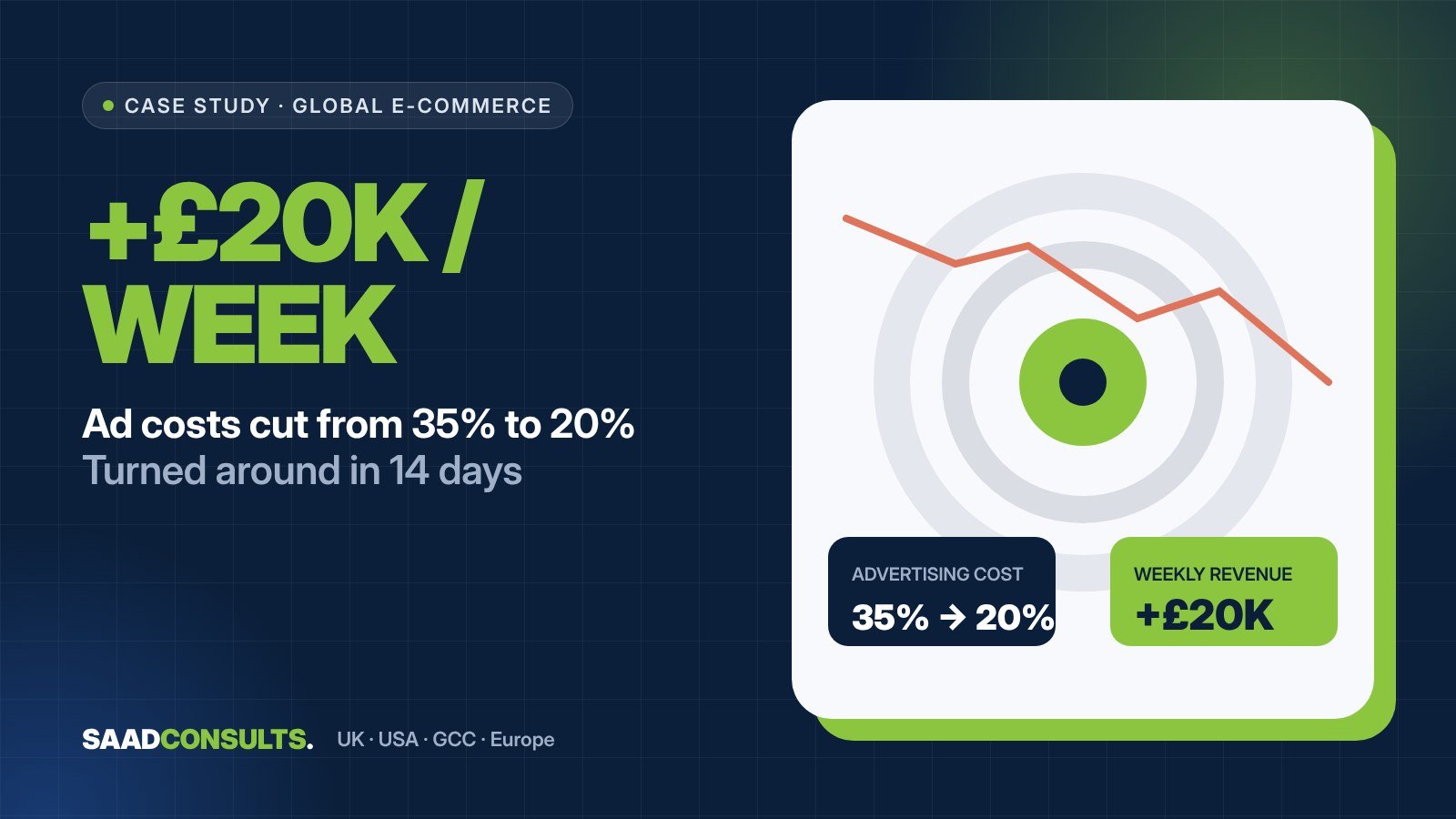
I’ve seen what tidying overlapping pages can do. For an e-commerce brand selling across the UK and Europe, cleaning up language versions that competed with each other helped lift organic search from 20% to 35% of traffic (case study). Removing confusion is often worth more than adding content.
What about AI-written reviews and testimonials?
This is where AI content stops being an SEO question. Since April 2025 the Digital Markets, Competition and Consumers Act has banned fake reviews, and the CMA can fine businesses up to 10% of global turnover for breaching consumer protection law (GOV.UK; Which?). A testimonial generated by a tool and presented as a customer’s words would be very hard to defend. Use AI to help a real customer tidy their own review if they ask, never to write one for them.
What AI content mistakes should UK businesses avoid?
- Deleting everything in a panic. Sort posts into keep, improve, merge and remove using real Search Console data.
- Publishing drafts the same day. No AI draft goes live without a named person checking it.
- Town pages with only the name swapped. Build location pages only where you have real local detail, jobs or staff.
- Trusting AI “detector” scores. Judge pages by accuracy, usefulness and experience instead.
Frequently asked questions
Does Google penalise AI-generated content?
Not for being AI-generated. Google’s spam policies target pages made at scale mainly to manipulate rankings with little value, however they were created.
Can Google detect AI content?
Google’s published policies focus on value and purpose, not detection. Edit drafts for accuracy and experience rather than trying to beat AI detectors.
Should I delete old AI blog posts?
Not in bulk. Review each post’s clicks and impressions, then keep, improve, merge or remove it, with redirects where a relevant page exists.
Can I use AI to write customer reviews?
No. Fake reviews are banned under the Digital Markets, Competition and Consumers Act, and the CMA can fine businesses up to 10% of global turnover.
Sources
- Google Search Central: spam policies
- Google Search blog, March 2024 update (updated 26 April 2024)
- Google Search Central: creating helpful content
- Ofcom, Online Nation 2025
- GOV.UK: new consumer protection regime
- Which?: fake reviews banned under new law
Client examples are from my own projects; names are withheld.
If your results with AI content look good in the dashboard but not in the bank, that gap can usually be closed. Request a free marketing audit and I will show you where to start, or send me a WhatsApp.

Saad is a digital marketing consultant and business growth strategist with 13+ years of experience, $200M+ in managed ad spend and 600+ clients worldwide. LinkedIn & profile →