“How do we get into the AI answer?” has replaced “how do we get to number one?” in a lot of US marketing meetings. Agencies are already selling special “AI optimization” packages: new files, new markup, new tricks.
Before you buy one, read what Google itself says. It’s shorter, and cheaper.
Key takeaways
- Google: no additional requirements and no special optimizations are needed for AI Overviews or AI Mode.
- Pages must be indexed and eligible for a snippet; SEO fundamentals still apply.
- In Pew’s study, only about 1% of visits included a click on a link inside the AI summary itself.
- Searches with an AI summary ended the browsing session more often: 26% vs 16%.
What does Google say it takes to appear in AI Overviews?
The official requirements are short
Google’s documentation states there are no additional requirements to appear in AI Overviews or AI Mode, nor special optimizations. A page needs to be indexed and eligible to be shown in Search with a snippet. Google also says you don’t need new machine-readable files, AI text files or special markup, and that meeting the requirements doesn’t guarantee a page will be crawled, indexed or shown (Google Search Central).
What that means in practice
If someone sells you an “AI Overview package” built around a magic file, be sceptical. The work that matters is unglamorous: making sure Google can crawl and index your important pages, that snippets aren’t blocked, and that each page answers a real question clearly.
How do AI summaries change clicks?
Pew Research Center analyzed the browsing of 900 US adults in March 2025, covering 68,879 Google searches, of which 12,593 produced an AI summary (Pew Research Center).
| Behavior | With an AI summary | Without |
|---|---|---|
| Clicked a traditional search result | 8% of visits | 15% of visits |
| Ended the browsing session after the page | 26% | 16% |
| Clicked a link inside the AI summary | About 1% of visits | Not applicable |
The lesson isn’t panic. It’s that being cited is a brand and trust win more than a traffic win, and that your conversion paths need to work for the smaller number of people who do click.
What should a US business do to get cited?
Answer first, explain second
Put a direct two or three sentence answer at the top of each important page, then the detail. Use headings that match how people ask the question. AI systems, like busy readers, quote what’s clear.
Make facts easy to lift
Prices, steps, specifications, opening hours, service areas: write them as plain text, not only in images or PDFs. Link the source for any statistic. A clean table often beats three paragraphs.
Show who’s behind it
Google’s guidance on helpful content asks “who, how and why”: clear authorship, how the content was made, and that it exists to help people rather than to rank. A named author with real experience, real case studies and real reviews is harder to fake than anything else on the page.
Fix the foundations before chasing features
Your free marketing strategy starts with your numbers
Move the sliders to see what your budget could return. Then get a free strategy built for your business: the right platforms, your budget split and your first 30 days.
Estimates based on Saad's campaign benchmarks across 26 niches. Not a guarantee. Your free strategy gives you a real plan.
Create your free strategy
- The right platforms, and what to post
- Your paid ads plan and budget split
- Your first 30 days, week by week
Want more? Stage 2 Advanced Strategy, USD 20 or hire me and my team for 100% digital coverage.
How do you check one page in 30 minutes?
You don’t need a tool subscription to start. Pick the page that matters most for revenue, usually a service page or your best-selling category, and walk through it the way a search engine and a hurried buyer would.
Minutes 1 to 10: can Google show it at all?
Open Search Console, paste the URL into URL Inspection and confirm it’s indexed. Look at the page source for a noindex tag or a nosnippet setting someone added years ago and forgot. Check that the canonical points to the page itself, not to a different version. If any of this fails, stop here: everything else is wasted until it’s fixed.
Minutes 11 to 20: would a stranger find the answer fast?
Read only the first screen. Does it say what you do, for whom, where and roughly what it costs or how it works? If the opening is a slogan and a stock photo, rewrite it as a plain answer. Then scan the headings. If they read like questions a customer would type, you’re in good shape.
Minutes 21 to 30: is there proof only you could give?
Count the details a competitor couldn’t copy: a named person with real experience, a project result, a photo of actual work, a specific process. Pages that could belong to any business in your category are the ones AI systems have least reason to quote.
What if fewer people click?
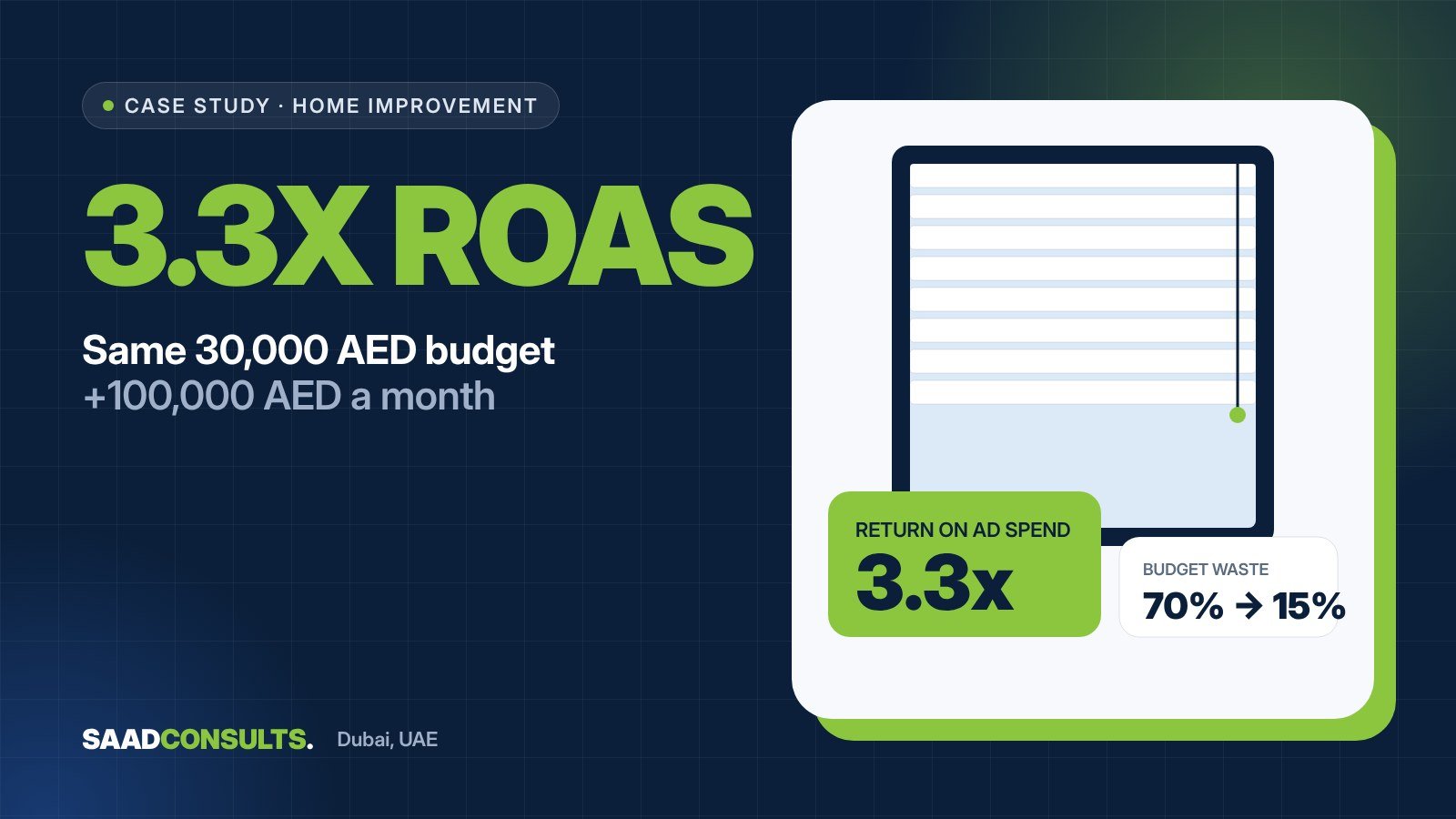
Then each click is worth more, and the page they land on has to work harder. I had a meeting with a Dubai window-blinds client whose traffic wasn’t the problem: returning visitors were converting at 5%. After we fixed the follow-up journey with remarketing and a clearer path back to a quote, that rate reached 20%, and revenue grew 3.3x on the same 30,000 AED budget (case study). The same logic applies in the US. If AI summaries thin out the top of your funnel, the businesses that win are the ones that capture and follow up properly with whoever does arrive: a fast form, a clear offer, an email or remarketing sequence, and a sales team that calls back the same day.
How should you measure AI search now?
Track branded searches over time, since being cited often increases searches for your name. Watch conversions per organic visit, not just organic visits. Check Search Console for queries where impressions grow while clicks don’t; those are often the searches where an AI summary appears. And ask new customers how they found you, because “I asked ChatGPT” and “Google’s AI answer mentioned you” are increasingly common replies that no analytics tool records.
What AI search mistakes should you avoid?
- Buying “AI optimization” tricks. Spend the budget on indexing, clear answers and expertise.
- Blocking snippets by accident. Check your important pages in Search Console’s URL Inspection tool.
- Mass-producing AI pages to “cover” every question. Fewer, better pages with real experience and checked facts.
Frequently asked questions
Can I pay to appear in Google AI Overviews?
Organic citations in AI Overviews can’t be bought. Google says pages need to be indexed and eligible for a snippet, with no special optimizations required.
Do I need an llms.txt file?
Google says you don’t need new machine-readable files, AI text files or markup to appear in AI Overviews or AI Mode.
Do AI Overviews reduce website traffic?
For some searches, yes. Pew found people clicked a traditional result in 8% of visits with an AI summary versus 15% without.
Does structured data help with AI Overviews?
Structured data helps Google understand pages, but Google says no special markup is required for these features. Make sure any markup matches what’s visible on the page.
Sources
- Google Search Central: AI features and your website
- Pew Research Center, July 22, 2025
- Google Search Central: creating helpful content
- Google Search Central: spam policies
Client results are from my own projects; names are withheld.
Want a second opinion on Google AI Overviews before you spend more? I review your setup personally and tell you plainly what I would fix first. Request the free audit, or message me on WhatsApp.

Saad is a digital marketing consultant and business growth strategist with 13+ years of experience, $200M+ in managed ad spend and 600+ clients worldwide. LinkedIn & profile →