In a meeting with the marketing manager of a Riyadh company, he showed me a dashboard from his SEO tool: a site health score of 92 out of 100, green ticks everywhere. Then he showed me Search Console. Clicks had been falling for months.
Both screens were telling the truth. The tool was measuring what it could measure easily. Google was measuring whether real people found the pages useful. That gap is where most of the money spent on AI SEO tools disappears.
Key takeaways
- Google handled 96.1% of searches in Saudi Arabia in October 2026, so Google’s own free tools are the right starting point.
- AI tools speed up research and drafting but often miss Arabic spelling and dialect variations.
- Google’s spam policies target scaled, low-value content however it’s created, including AI-generated pages.
- Don’t upload customer data to SEO or AI tools without checking PDPL obligations.
What do AI SEO tools actually do well?
Most tools sold as “AI SEO” combine four jobs. Each one is useful when you know what it can’t see.
| Tool type | What it does well | What it often misses in Saudi Arabia |
|---|---|---|
| Keyword research | Expands seed terms and groups them by topic in minutes | Arabic spelling variants, dialect terms and Arabizi; thin volume data for long-tail Arabic searches |
| Content briefs and drafts | Outlines, headings and first drafts | Saudi examples, local prices and regulations, and anything only your team knows |
| Site audits and crawlers | Finds broken links, missing tags and slow pages at scale | Which issues actually hurt rankings; scores can look healthy while traffic falls |
| Reporting assistants | Summarises Search Console and analytics data | The business reason behind a change, such as a season, a competitor or a price move |
Where do AI SEO tools fall short in Arabic?
The same search written five ways
Saudi searchers write the same idea in many forms: formal Arabic, Gulf dialect, English, mixed Arabic and English, and different spellings of the same word. “SEO” alone can appear as سيو, تحسين محركات البحث, or the English term. A tool that only expands your formal Arabic seed keyword will miss a large part of how your customers actually search.
Local detail the tool can’t know
District names in Riyadh, the difference between what buyers expect in Jeddah and Dammam, the right price range for your category, the months when demand moves. AI tools can format this information. They can’t supply it.
Audit scores versus real problems
A crawler treats a missing image description on a blog post and a blocked category page as two items on a list. They aren’t equal. Someone has to decide what to fix first, and that decision is where experience pays.
Which tools should a Saudi business start with?
Google handled 96.1% of searches in Saudi Arabia in October 2026, with Bing on 2.69% (StatCounter). So the most valuable data you can have comes from Google itself, and much of it is free.
Google Search Console first
It shows the searches you already appear for, in every spelling people actually used, with clicks and impressions. That’s better Arabic keyword research than most paid tools, because it’s your real data. Export it, then ask an AI tool to group the queries by topic and intent. You check the groups.
Google Business Profile for local searches
If you serve customers in specific cities, your profile is often what appears first. Keep the Arabic and English names consistent, add services, photos and real opening hours, and reply to reviews.
Paid AI tools to go faster, not to decide
Once you know what matters, paid tools save time on crawling, briefs and reporting. Choose one, use it properly for three months and judge it by the traffic and leads that follow, not by its own scores.
Four questions before you pay for any tool
Does it handle Arabic properly, including right-to-left reports and Arabic keyword data for Saudi Arabia, not just the wider region? Can it connect to your own Search Console data, or does it rely only on estimates? Where does it store anything you upload, and can you delete it? And will someone on your team actually use it every week? If the honest answer to the last question is no, the subscription is a donation.
Your free marketing strategy starts with your numbers
Move the sliders to see what your budget could return. Then get a free strategy built for your business: the right platforms, your budget split and your first 30 days.
Estimates based on Saad's campaign benchmarks across 26 niches. Not a guarantee. Your free strategy gives you a real plan.
Create your free strategy
- The right platforms, and what to post
- Your paid ads plan and budget split
- Your first 30 days, week by week
Want more? Stage 2 Advanced Strategy, SAR 75 or hire me and my team for 100% digital coverage.
What happens when the basics are fixed properly?
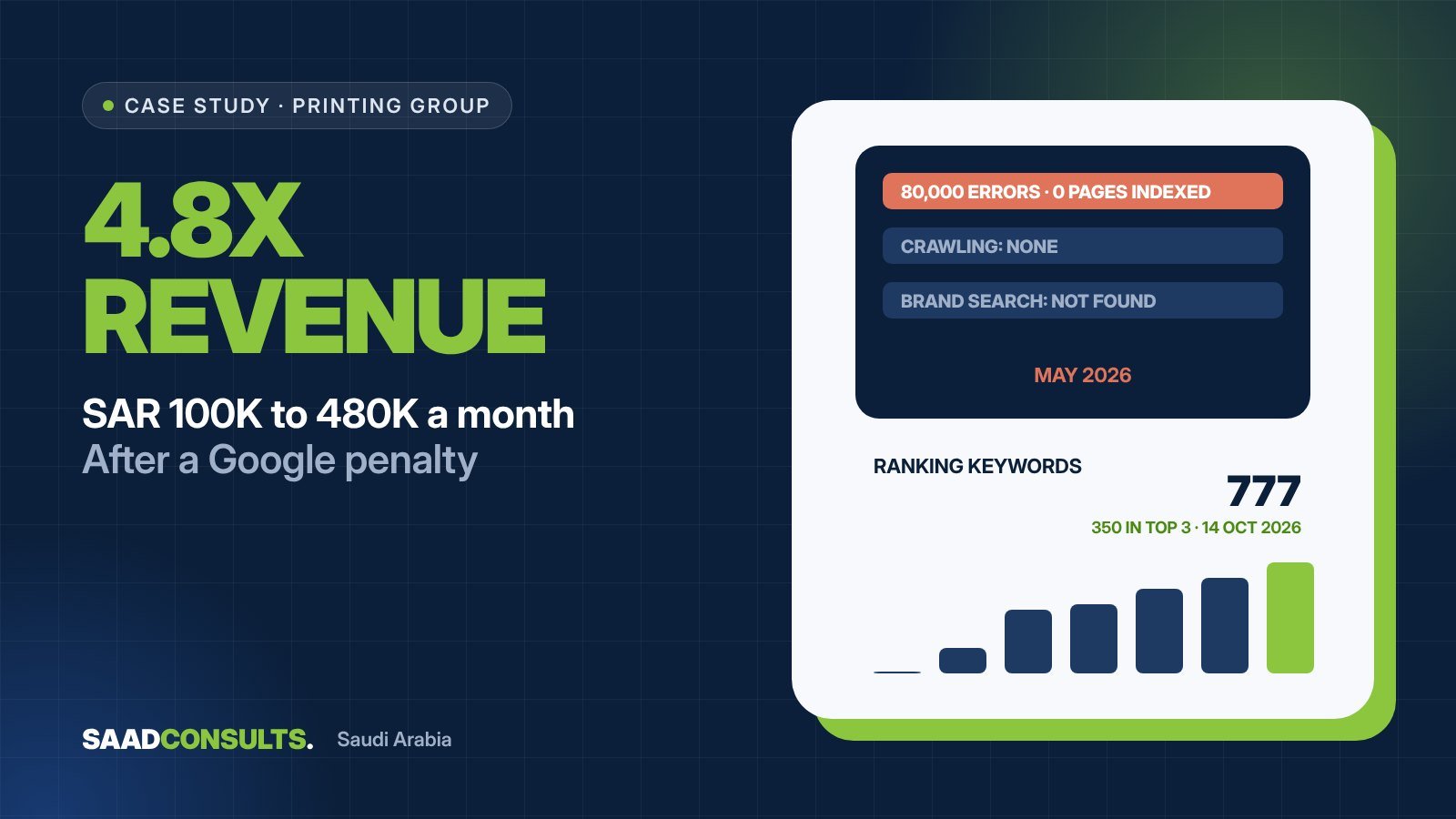
A Saudi printing group I worked with had dropped out of Google entirely. Its site had only about 40 pages but around 80,000 technical errors. Fixing the ones that mattered, in the right order, took it from zero to 777 ranking keywords, 350 of them in the top three. Monthly sales went from SAR 100,000 to SAR 480,000, and the business generated 1,500 B2B leads in three months, 75% of them sales-qualified (case study).
Tools found the errors. Deciding which ones were blocking the business, and rebuilding the pages around how Saudi buyers search for printing, was the work.
What about AI-written pages and customer data?
Mass-produced pages are a risk
Many AI SEO tools now offer to generate hundreds of pages at once. Google’s spam policies describe scaled content abuse as many pages generated mainly to manipulate rankings with little value, however they’re created (Google Search Central). Fifty city pages that differ only by name fit that pattern. Use AI to draft fewer, better pages.
Check PDPL before uploading data
Some tools ask you to upload customer lists or connect CRM data. Saudi Arabia’s Personal Data Protection Law has been fully enforceable since 14 September 2024, requires opt-in consent for direct marketing and allows fines of up to SAR 5 million, which can be doubled for repeat offences (CMS). Enforcement decisions have already covered promotional messages sent without consent (A&O Shearman). Find out where a tool stores data before you give it any.
What AI SEO tool mistakes do Saudi businesses make?
- Chasing the tool’s score. Judge SEO by Search Console clicks, leads and sales.
- Researching only in formal Arabic. Start keyword research from your own Search Console queries.
- Publishing generated pages in bulk. Fewer pages, each with real local detail and a named expert.
Frequently asked questions
What is the best AI SEO tool for Arabic?
Start with Google Search Console, because it shows the real Arabic and English searches you already appear for. Paid AI tools help you go faster once you know which searches matter.
Can AI write SEO content that ranks in Saudi Arabia?
AI can draft it. Pages rank when a person adds Saudi detail, real experience and accurate facts. Google’s spam policies target mass-produced low-value pages however they’re made.
Do I need to worry about Bing in Saudi Arabia?
Google handled 96.1% of searches in October 2026 and Bing 2.69%, so Google comes first for almost every business.
Is it safe to upload customer data to SEO tools?
Check first. Saudi Arabia’s PDPL governs personal data, requires consent for direct marketing and carries fines of up to SAR 5 million.
Sources
- StatCounter: search engine market share, Saudi Arabia (October 2026)
- Google Search Central: spam policies
- CMS: Saudi Personal Data Protection Law
- A&O Shearman: PDPL enforcement
Client results are from my own projects; names are withheld.
If your results with AI SEO tools look good in the dashboard but not in the bank, that gap can usually be closed. Request a free marketing audit and I will show you where to start, or send me a WhatsApp.

Saad is a digital marketing consultant and business growth strategist with 13+ years of experience, $200M+ in managed ad spend and 600+ clients worldwide. LinkedIn & profile →