Website accessibility lawsuits filed in US federal court rose to 3,117 in 2025, up 27% from 2,452 in 2024, with New York, Florida and Illinois leading, according to the law firm Seyfarth Shaw’s annual count (Seyfarth Shaw, ADA Title III blog). That count doesn’t include state courts or demand letters. Most of those businesses never thought of their website as a legal risk. They thought of it as a brochure.
A meeting I’ve had in many versions with US owners: a family-run company with a website that cost real money two years ago. It looks great on the owner’s laptop. On my phone, the menu covers half the screen, the quote form has nine fields and the analytics account has recorded nothing since a plugin update. “But the agency said it was SEO-friendly,” the owner says. Nobody lied. Nobody checked whether the site was doing its job.
Website development is not buying a design. It is building the place where your ads, SEO, social media and email all land, where marketing money becomes customers or gets wasted. Below is what I’d walk you through before any proposal.
Key takeaways
- A business website has four jobs: convert, rank, get cited by AI search and track. A site that only looks good does none of them.
- WordPress runs about 39.5% of all websites and Shopify about 5.3% (W3Techs, October 2026). Choose by business model, not by what your developer prefers.
- Only 48% of mobile sites passed Core Web Vitals in 2025 (HTTP Archive), and 95.9% of the top million home pages had detectable WCAG failures (WebAIM 2026). Speed and accessibility are where most sites lose.
- US privacy rules shape how you track: consent and opt-out tools belong in the build, not added after a demand letter.
- Measure the website on leads, sales and cost per customer, and own your domain, hosting, code and analytics from day one.
What should website development services in the USA deliver in 2026?
Most proposals describe pages, a theme and rounds of revisions. Those are inputs. The outputs you pay for are the four jobs below.
What does a business website need to do besides look good?
It needs to make the next step obvious and easy, on a phone. In September 2026 mobile devices produced 49.04% of US web traffic and desktops 48.55% (StatCounter), so half your visitors judge you on a small screen, often with one thumb. In practice that means one main call to action per page, a phone number that is a tap-to-call link, forms with only the fields your sales team truly uses, trust signals (reviews, licenses, guarantees) near the button, and a checkout that doesn’t force account creation.
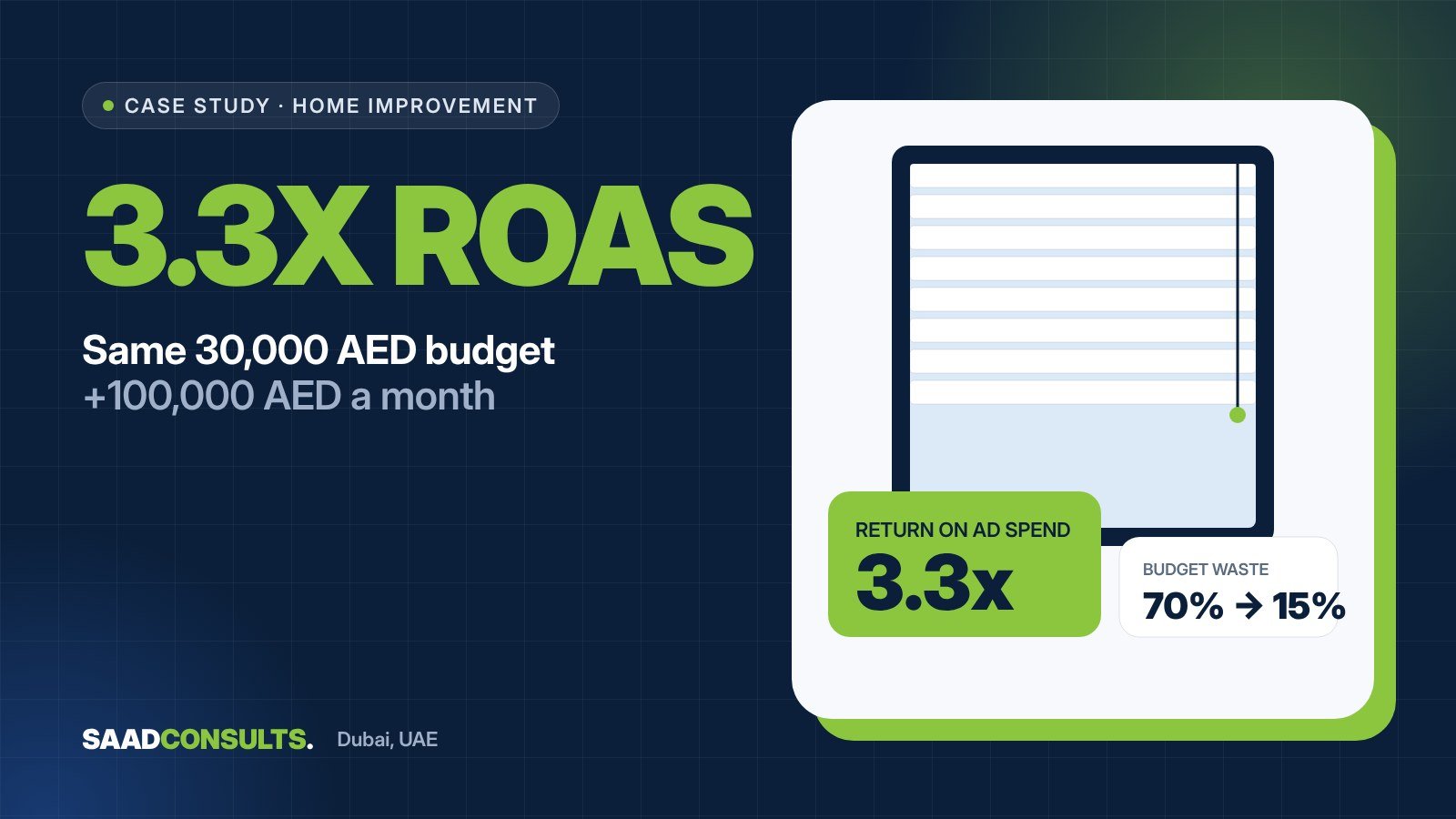
I learned how much this matters on a home improvement group’s site I worked on in Dubai. Behavior reports showed the home page converted better than the category and product pages, which were exactly where the ads sent people. Moving the calls to action, surfacing best-sellers, adding certifications and reviews and cleaning up the layout, alongside fixing tracking and campaign structure, took the account to 3.3x ROAS and lifted leads from about 300 to 500+ a month on the same spend. The details are in the blinds and curtains case study.
How do you build a website that gets cited by AI search?
Mostly by doing the basics properly, which is good news. Google says plainly that there are no extra requirements and no special optimizations needed to appear in AI Overviews or AI Mode: a page has to be indexed and eligible to show with a snippet. It recommends allowing crawling, linking internally, keeping important content in text, giving a good page experience and making structured data match the visible text. It also says you don’t need new “AI text files” or special markup (Google Search Central).
So every service and product page I plan answers buyers’ real questions in sentences a machine can quote: what it is, who it’s for, how pricing works, where you serve and why you’re credible. Business details stay identical everywhere, and proof is published as text, not trapped in images. A page that is clear for Google tends to be clear for ChatGPT, Gemini and Perplexity too. My SEO and AI search services cover the ongoing side.
What tracking should a new website have from day one?
Enough to answer one question: which channel brought in the customers who paid you? That means GA4 and Tag Manager, conversion events for every form, call and purchase, ad platform conversions and leads passed into your CRM with their source, all behind a consent tool (more below). I test this before launch, or you lose the chance to compare old and new performance. If your current tracking is shaky, my CRO and marketing automation work starts there.
WordPress, Shopify or custom: which platform fits a US business?
Platform choice decides your running costs, who can maintain the site and how far it can grow. W3Techs’ data from 30 October 2026 shows how the market splits (W3Techs):
| Platform | Share of all websites | Share of sites using a CMS | Best fit |
|---|---|---|---|
| WordPress | 39.5% | 58.2% | Lead generation, service businesses, content-heavy sites, WooCommerce stores |
| Shopify | 5.3% | 7.9% | E-commerce of almost any size, especially D2C brands |
| Wix | 4.2% | 6.1% | Very small sites the owner edits alone |
| Squarespace | 2.4% | 3.6% | Portfolios, simple brochure sites |
| Webflow | 0.8% | 1.2% | Design-led marketing sites with an in-house designer |
| No CMS detected | 32.1% | n/a | Custom builds, headless sites, static sites |
Source: W3Techs, usage statistics of content management systems, 30 October 2026. “Best fit” is my own view from client work.
When is WordPress the right choice for a business website?
When your site’s main job is generating leads and ranking for many searches. A law firm, a roofer in Phoenix or a clinic group needs service and location pages, a blog, ad landing pages and forms that feed a CRM. WordPress handles all of that, any developer can maintain it and you own the files. The trade-off is upkeep, and a site with forty plugins and a heavy page builder will be slow; a lean build can be fast. That discipline is what I build on my WordPress website development projects.
Is Shopify better than WooCommerce for e-commerce in the USA?
For most stores, yes. Shopify takes hosting, security and checkout off your plate. WooCommerce makes sense when content and SEO drive most sales, when you need unusual product logic, or when you’d rather own the maintenance than pay platform fees. On Shopify, watch the apps: they can cost more than the plan.
When does a custom or headless website make sense?
A headless build separates the content system from the front end, often a JavaScript framework fed by WordPress or Shopify. It can be very fast, but it costs more, needs a developer for most changes and is easy to get wrong for SEO if content depends on scripts. I recommend it only for a concrete reason: a customer portal, complex integrations, very high traffic or a product team to maintain it. “It’s more modern” is not a reason.
What technical standards must a US business website meet?
Speed, accessibility and privacy are invisible on the launch-day demo and expensive to fix later.
What are Core Web Vitals and what scores does your site need?
Core Web Vitals are Google’s three measures of real-user experience. Google’s thresholds for a good score are a Largest Contentful Paint (main content loaded) within 2.5 seconds, an Interaction to Next Paint (response to taps and clicks) of 200 milliseconds or less, and a Cumulative Layout Shift (how much the page jumps) of 0.1 or less. They are measured at the 75th percentile of real visits, separately for mobile and desktop. INP replaced First Input Delay in 2024 (web.dev, Google).
Most sites don’t meet them. The HTTP Archive’s 2025 Web Almanac, based on July 2025 data, found that only 48% of mobile sites and 56% of desktop sites had good Core Web Vitals (HTTP Archive Web Almanac). The usual causes: oversized images and videos, too many third-party scripts, heavy page builders and cheap hosting. I write performance targets into the scope.
Does a US business website need to be ADA compliant?
The honest answer, which isn’t legal advice: there is no detailed federal web standard for private businesses under ADA Title III, but courts have accepted website claims. Here is where federal suits cluster:
Two more facts set the standard in practice. For state and local governments, the Department of Justice requires WCAG 2.1 Level AA; on April 20, 2026 it pushed the compliance dates back one year, to April 26, 2027 for larger entities and April 26, 2028 for smaller ones (Duane Morris). That rule doesn’t apply to private businesses directly, but WCAG 2.1 AA is the benchmark plaintiffs, courts and settlements point to. And the web as a whole is far from it: the 2026 WebAIM Million found detectable WCAG failures on 95.9% of the top million home pages, averaging 56.1 errors each. The most common were low-contrast text (83.9% of pages), missing alt text (53.1%) and missing form labels (51%) (WebAIM).
Those errors are cheap to avoid at build time. I build to WCAG 2.1 AA and test with automated tools and a keyboard before launch, rather than relying on “overlay” widgets that don’t change the underlying code.
Which US privacy laws affect website tracking and cookie consent?
With no single federal privacy law, the rules come from a growing list of state laws plus older statutes applied to modern tracking. In California, lawsuits under the California Invasion of Privacy Act (CIPA) argued that pixels and cookies on websites worked like illegal “pen register” or wiretap devices. On September 30, 2026 Governor Newsom signed SB 690, which removes the private right to sue over the pen register and trap-and-trace provision for website and app tracking and applies to pending claims; the Attorney General can still enforce it, and other claims, such as recording the contents of communications without consent, remain (WilmerHale).
The risk shifted; it didn’t disappear. Your attorney should approve your privacy policy, but the build should include:
- A consent tool that honors opt-outs and browser signals such as Global Privacy Control where state law requires, and really blocks the tags it says it blocks.
- A “Do not sell or share my personal information” link where it applies.
- An inventory of every pixel, chat widget and session-recording tool. Fewer tools means less exposure and a faster site.
Your free marketing strategy starts with your numbers
Move the sliders to see what your budget could return. Then get a free strategy built for your business: the right platforms, your budget split and your first 30 days.
Estimates based on Saad's campaign benchmarks across 26 niches. Not a guarantee. Your free strategy gives you a real plan.
Create your free strategy
- The right platforms, and what to post
- Your paid ads plan and budget split
- Your first 30 days, week by week
Want more? Stage 2 Advanced Strategy, USD 20 or hire me and my team for 100% digital coverage.
How much do website development services cost in the USA?
I haven’t found a trustworthy published source for typical US website build prices. Online “average cost” figures range so widely, and are so often written by companies selling one tier, that they mislead more than they help. What I can give you are published running costs and the official wage data that sit behind any quote, plus a method to judge a price.
| Cost line (USD) | Published figure | What it tells you |
|---|---|---|
| Shopify Basic | $29/month billed yearly ($39 monthly); online card rate 2.9% + 30¢ | Entry cost for a small store |
| Shopify Grow | $79/month billed yearly ($105 monthly); 2.7% + 30¢ | Growing stores with more staff and reports |
| Shopify Advanced | $299/month billed yearly ($399 monthly); 2.5% + 30¢ | Higher volume, lower card rate |
| Shopify Plus | From $2,300/month; 2.25% + 30¢ | Enterprise and high-volume brands |
| Web developers, median pay (May 2025) | $92,650 a year | Wage only, before benefits and tools |
| Web and digital interface designers, median pay (May 2025) | $104,000 a year | UX and UI design talent is not cheap |
| Web developers and digital designers combined, median hourly (May 2025) | $47.85 an hour | An employee wage, not an agency billing rate |
Sources: Shopify pricing (US, October 2026); US Bureau of Labor Statistics, Occupational Outlook Handbook: Web Developers and Digital Designers.
How much does it cost to run a WordPress or Shopify website?
On Shopify, add up the plan, card fees on expected sales, the theme and every paid app. On $40,000 of monthly online sales, a 0.2-point difference in card rate is $80 a month, which is why higher plans can pay for themselves at volume. On WordPress the software is free, but hosting, premium plugins, backups, security and updates are not. Ask any provider for a written first-year cost, not just the build fee.
Freelancer, agency or in-house developer: which costs less?
An in-house developer is always available, but the BLS figures are wages alone, and one hire rarely covers design, development, SEO, copy and analytics. A freelancer is cheapest per hour if you can manage the project yourself. An agency brings a team at agency rates, often run by an account manager. What I offer sits between: one senior person who owns the outcome and brings in specialist developers and designers where needed.
How do you calculate ROI from a new website?
Use the same formula you’d use for ads: ROI = (extra gross profit from the website − total website cost) ÷ total website cost, with cost covering the build plus the first year of running costs. Record your baseline first. An illustrative example: a site with 5,000 monthly visitors converting at 1% gives 50 leads; if the rebuild takes conversion to 1.5% at the same traffic, that’s 25 extra leads a month. At a 20% close rate and $2,000 gross profit per customer, that’s $10,000 in extra monthly gross profit. Use your own numbers, and if you can’t measure the baseline, fix tracking first.
How do you choose a website developer or web design company in the USA?
Most bad website projects were bad choices at the proposal stage, when nobody asked about leads, speed, accessibility or ownership.
What should you ask a web design company before signing?
- How will you measure success? Look for leads, sales and conversion rate, not “a modern look”.
- What Core Web Vitals and accessibility standard will you deliver? Ask for targets in writing: passing Core Web Vitals on mobile and WCAG 2.1 AA.
- What happens to my current rankings? A good answer includes a URL map, 301 redirects, and a check of Search Console after launch.
- How will tracking and consent work? If they say “we’ll add Google Analytics,” keep asking.
- Can I see results, not just designs? Ask what changed in leads or sales for a past client.
Who should own the domain, hosting and website code?
You should, always. Register the domain in your company’s name, open hosting, Shopify, analytics and ad accounts under your business and give the developer user access. Write ownership of design and code into the contract. I’ve met owners locked out of their own site because the agency held the hosting.
Can AI website builders replace a web developer?
For a placeholder page, sometimes. For a site that has to bring in business, no. I use AI daily to draft copy, check code and speed up audits. But AI doesn’t know your margins or best customers, and it happily produces pages that look finished while failing accessibility checks or missing tracking. AI is a strong assistant; someone experienced still has to direct it and own the results.
What are the most common website development mistakes US businesses make?
These are the problems I find most often when I audit a US business website, and almost none of them are about design taste.
- Why does my new website look great but bring in fewer leads?. One clear offer and call to action per page, short forms, tap-to-call on mobile, proof next to the button, and a conversion rate target agreed before design starts.
- Redesigning without a redirect plan and losing Google rankings. Crawl the old site, map every URL with traffic or links to its new address, test redirects on staging and watch Search Console daily for the first weeks after launch.
- Treating ADA accessibility as something to fix later. Make WCAG 2.1 AA part of the written scope, test before launch with automated tools and keyboard-only navigation, and skip overlay widgets as a substitute.
- Launching a website with no tracking or consent setup. Set up GA4, Tag Manager, conversion events, call tracking and a consent tool before launch, and test every form and purchase end to end.
- Is a slow website hurting my Google rankings and sales?. Set Core Web Vitals targets in the contract, compress media, cut unused scripts and plugins, and pay for hosting that matches your traffic.
Frequently asked questions
How long does it take to build a business website in the USA?
It depends on scope and how fast content and approvals arrive. A focused lead-generation site can take weeks; a large e-commerce migration takes longer. Content is the most common cause of delay.
Should I redesign my website or fix the one I have?
Fix first if the platform is sound and the problems are speed, forms, tracking or content. Rebuild when the platform can’t be maintained, the structure blocks SEO, or fixes would cost close to a new build. An audit of conversion, speed and accessibility usually makes the answer clear.
Is WordPress secure enough for a business website?
Yes, when it is maintained. Most problems come from outdated plugins and themes, weak passwords and cheap hosting. Keep the plugin list short, update regularly, use managed hosting with backups and firewall protection, and give each user only the access they need.
Do I need a separate Spanish version of my website?
If a meaningful share of your customers prefer Spanish, a proper Spanish version with its own pages, set up with hreflang tags, usually converts better than an automatic translation widget. Build it with the same care as the English site, including forms and follow-up in Spanish.
Sources
- Seyfarth Shaw, ADA Title III blog: federal court website accessibility lawsuit filings in 2025 (March 2026)
- StatCounter, desktop vs mobile vs tablet market share in the United States (September 2026)
- Google Search Central, AI features and your website
- W3Techs, usage statistics of content management systems (30 October 2026)
- web.dev (Google), Web Vitals and Core Web Vitals thresholds
- HTTP Archive, Web Almanac 2025: Performance (July 2025 data)
- Duane Morris, DOJ extends ADA Title II digital accessibility deadlines by one year (April 2026)
- WebAIM, The WebAIM Million 2026
- WilmerHale, CIPA reform (SB 690) signed into law (October 2026)
- Shopify, plans and pricing (US)
- US Bureau of Labor Statistics, Web Developers and Digital Designers (May 2025 wages)
- Results mentioned are from Saad’s real client work, shared without client names.
Have a question about website development services in the USA that this guide did not answer? Send me the details and I will reply personally. Start with the free audit, or reach me on WhatsApp.

Saad is a digital marketing consultant and business growth strategist with 13+ years of experience, $200M+ in managed ad spend and 600+ clients worldwide. LinkedIn & profile →