This university had everything you'd want to market: a strong academic name, more than 60 programmes and a loyal alumni base. What it didn't have was a single official place online where a student could find it.
Students were finding the wrong pages first
Search the university's name on Facebook and you'd find dozens of pages: student groups, old admission pages and pages run by agents. None were official. Prospective students were getting outdated dates, wrong fees and broken contact numbers before they ever reached the real university.
That created two problems at once. Applicants didn't know whom to trust, and any money spent on ads had no verified home to send people to. Meanwhile, competing universities were outspending them many times over.
- No verified social media presence, and dozens of unofficial pages
- More than 60 courses, but no dedicated path from interest to application
- No link between marketing data and the admissions system
- A budget that was a fraction of what competitors were spending
You can't advertise your way out of a trust problem.
The plan
Reclaim the identity before spending a cent
I claimed every official handle and worked through clearing out the unofficial pages. This wasn't housekeeping. It was the foundation, because ads pointing to a confusing, fragmented presence create doubt, not applications.
A landing page for every course category
A student searching for engineering doesn't want a generic "Apply Now" page. I built landing pages by department, each matched to the ad that sent people there, and connected them directly to the university's ERP. Every form became a real applicant record instantly, with no manual entry and no lost leads.
Spend only where students are actively looking
With a tight budget and 60+ programmes, broad awareness was off the table. I targeted high-intent signals on Facebook, Instagram and Google: students searching for admissions, showing interest in specific programmes and living in the right areas.
Let the admissions data steer the budget
Because marketing and admissions were connected, I could see which ads produced confirmed applicants, not just clicks. Budget moved to those ad sets every day.
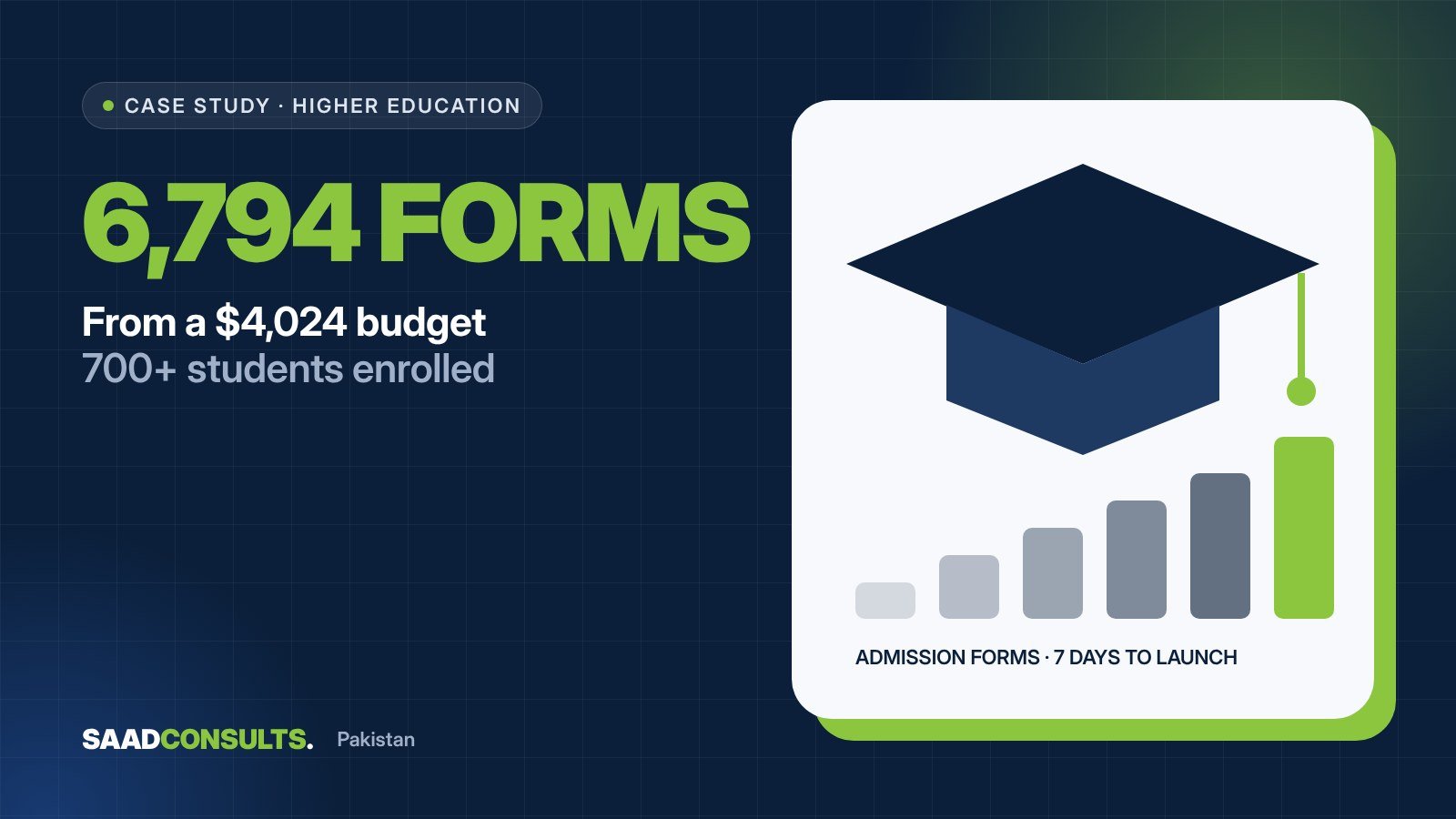
From audit to live campaigns took seven days.
The results
| Metric | Before | After |
|---|---|---|
| Facebook & Instagram spend | None | $3,874 |
| Admission forms from social | None | 6,655 |
| Google Search spend | None | ~$150 |
| Admission forms from search | None | 139 |
| Cost per admission form | Unknown | Under $0.60 |
| Prospectus sales (first quarter) | Low | PKR 1M (~$3,571) |
| Confirmed enrolments | Declining | 700+ in a single session |
Facebook and Instagram produced 6,655 admission forms from $3,874, under 60 cents per form. Google Search added 139 forms from roughly $150. Those are students who were already searching for a university, the closest to enrolling.
The most important number isn't the forms, though. It's the 700+ students who confirmed enrolment in a single session, plus PKR 1 million in prospectus sales in the first quarter. That's the difference between a lead generation campaign and an admissions campaign: people followed through.
The lesson
Education campaigns rarely fail because the budget is small. They fail because the infrastructure underneath is broken: fake pages, untracked forms and one generic landing page for every course. Fix that, and every dollar has somewhere useful to go.
Running admissions this season?
My free audit will show you how many applicants you're losing between the ad and the application, and how to get them back before intake closes.