Lead Generation Services in PakistanQualified leads. Not just form fills.
6 million leads generated across 26 industries taught me one thing: volume is easy, quality is the job. I build lead generation systems that filter, score and hand over buyers your sales team actually wants to call.
Lead generation results
Why most leads never convert
Every sales team I've worked with has said the same thing at some point: "the leads are rubbish." And they're usually right. Cheap forms, broad targeting and no qualification create a flood of names and very few customers.
My lead generation work starts from the other end. Who does your sales team close? What do those people have in common? Then I build campaigns, forms and landing pages that attract them and filter everyone else out before they reach your phone.
Every lead is tracked from first click to closed deal, so we know exactly which campaigns produce revenue.
- Forms ask for nothing, so anyone fills them
- No difference between raw, marketing and sales-qualified leads
- Leads wait hours or days for a call
- Marketing reports leads, sales reports nothing
- Cost per lead looks great, cost per sale doesn't
A complete lead engine
Ideal customer profile
Who actually buys, built from your sales data.
Multi-channel campaigns
Google, Meta, LinkedIn, YouTube and TikTok, chosen by where buyers are.
Qualifying forms
Questions that filter for budget, timing and intent.
Conversion landing pages
Pages built for one audience and one action.
Learn moreLead scoring & CRM
Automatic routing so hot leads get called first.
Learn moreClosed-loop reporting
Cost per qualified lead and cost per sale, by campaign.
From click to customer
I define MQL and SQL with your sales team before launch, so everyone agrees what a good lead looks like and we optimise for that, not for volume.
Define the buyer
Profile, qualifiers and lead stages agreed with sales.
Build the funnel
Campaigns, forms, pages and CRM routing.
Launch & qualify
Leads scored and handed over in real time.
Optimise to revenue
Budget follows the campaigns that close.
Lead generation results
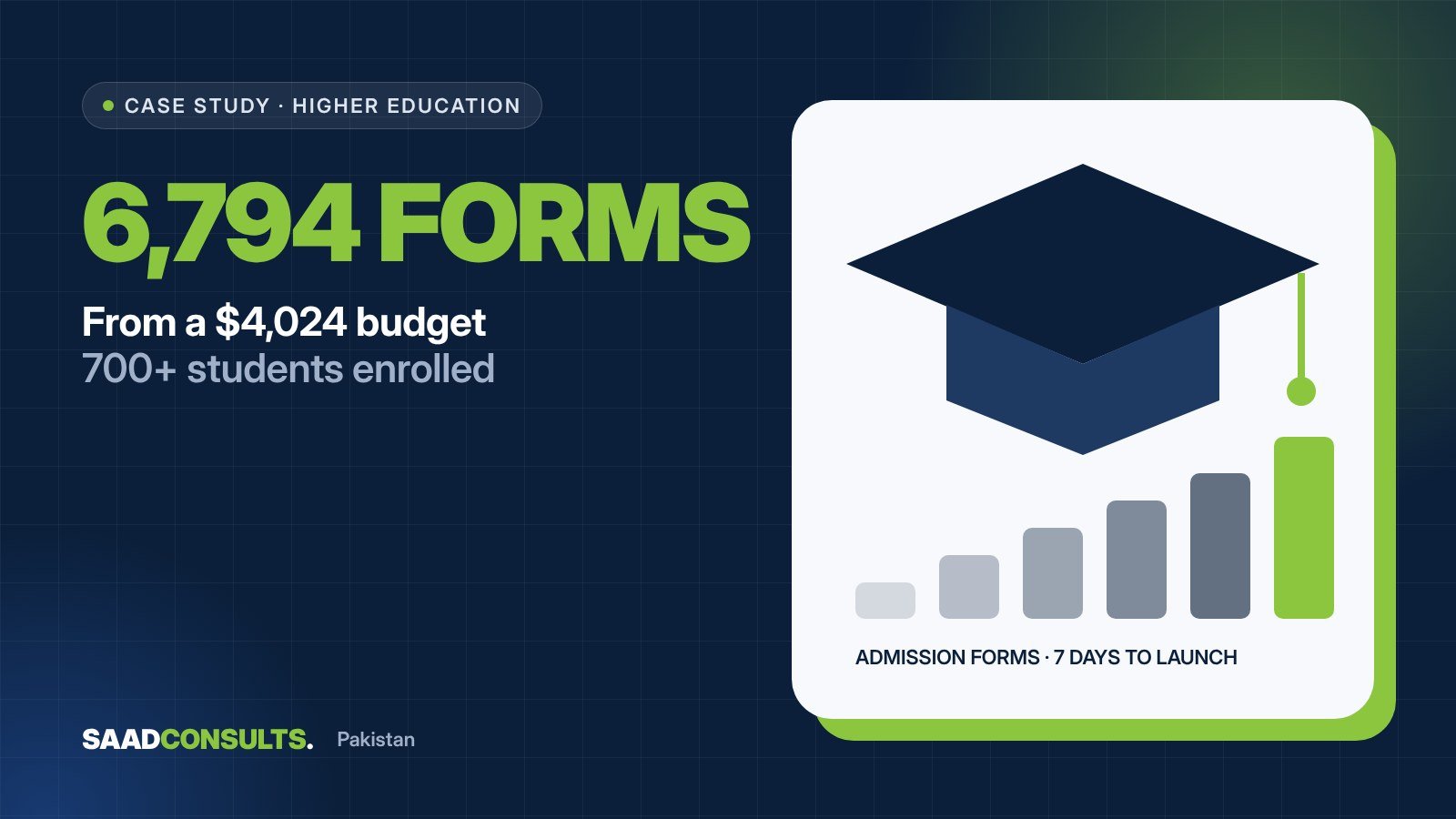
6,794 admission forms from a $4,024 budget for a regional university
Fake pages, 60+ courses and a tiny budget. Live in 7 days, 700+ students enrolled.
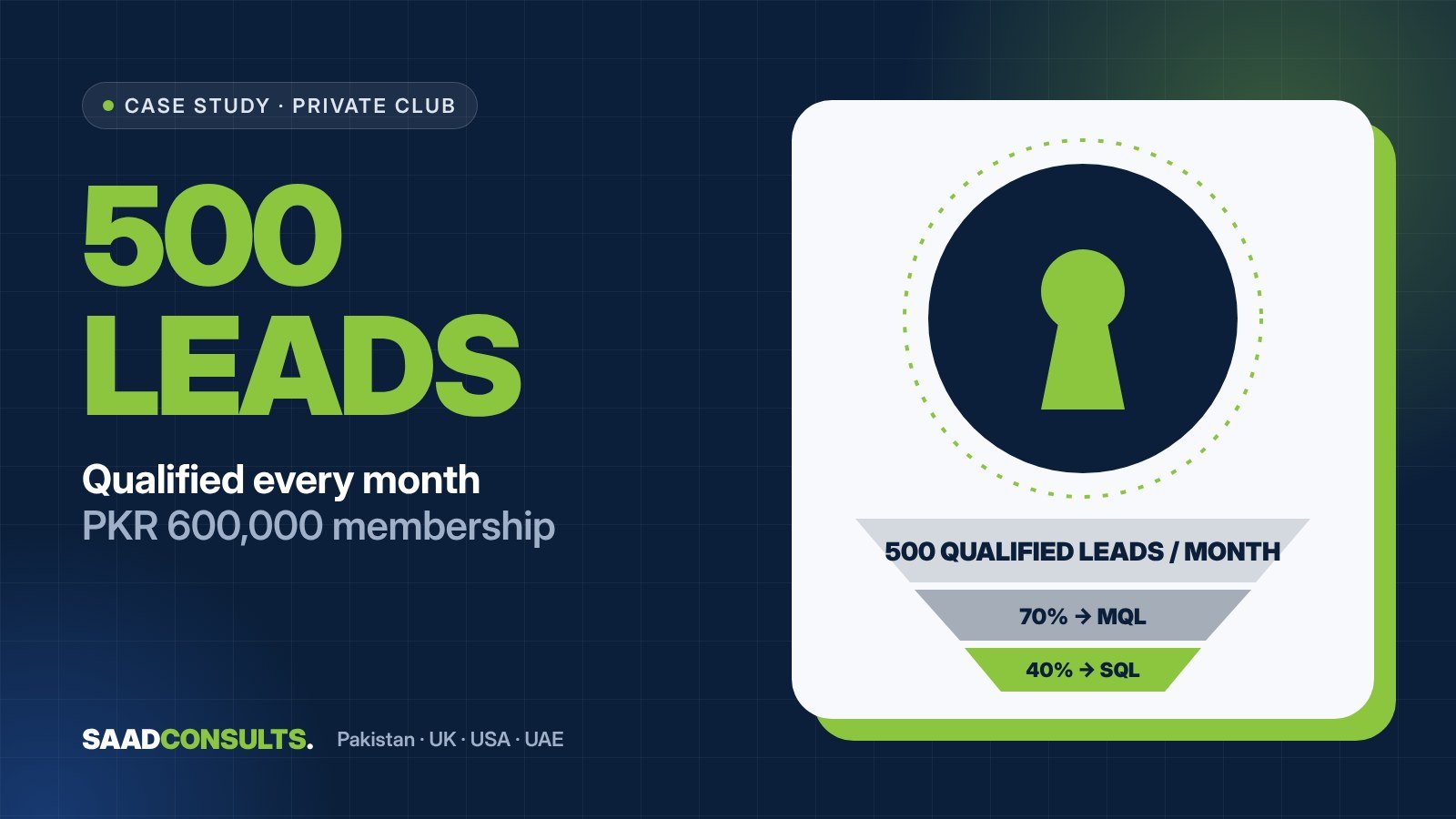
500 qualified prospects a month for a PKR 600,000 private club membership
Selling belonging, not a building. Curation beat reach.
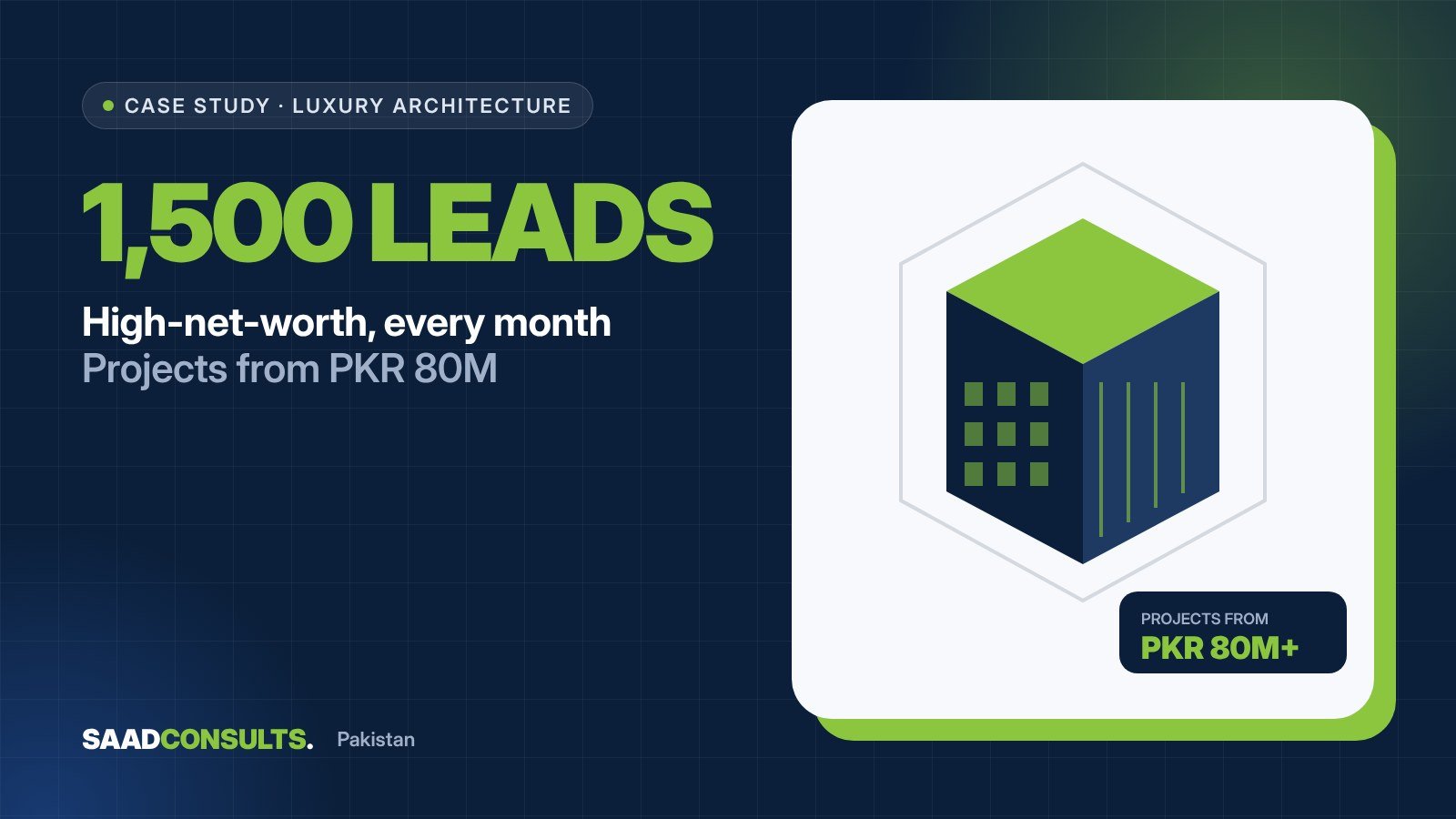
1,500 high-net-worth leads a month for a luxury architecture firm
A tiny, loyal market. We entered the competitors' conversation instead.
Works best together
Growth rarely comes from one channel. These services pair naturally with this one.
From first call to results in 5 steps
No months of onboarding. We start with a conversation and move fast.
Meeting
A focused call about what happened, your goals and your numbers.
Audit
I check your ads, tracking, website, funnel, sales process and team.
Strategy
Quick wins for breathing space, plus a long-term roadmap.
Execution
I build, launch and fix, with your team or alongside it.
Scaling & reporting
We scale what works. You get honest reports on leads, sales and ROI.
Lead generation questions
What is a qualified lead?
A lead that matches your buyer profile and has shown real intent, for example by answering qualifying questions about budget and timing. We agree the definition with your sales team.
Do you sell lead lists?
No. Every lead comes from campaigns run for your business, so they've actually asked to hear from you.
Which channels work best for lead generation?
It depends on your audience. High-ticket B2C often works best on Meta and YouTube; B2B on LinkedIn and Google Search.
Can you connect leads to my CRM?
Yes. I set up routing into HubSpot, Zoho, Bitrix24 or your ERP, as I did for a university's admissions system.
How do you measure success?
Cost per qualified lead and cost per sale, not just cost per lead.
How much does lead generation cost in Pakistan?
It depends on your industry, target audience, channels and how qualified the leads need to be. A lead for a local service costs far less than one for property or B2B software. I do not quote fixed prices; after a free marketing audit I can estimate realistic costs per lead for your market and share a custom proposal.
What is the difference between B2B and B2C lead generation?
B2B lead generation targets businesses and decision-makers, usually with longer sales cycles and higher deal values, using channels like LinkedIn, Google search and email. B2C targets individual consumers, often through Facebook, Instagram, TikTok and Google, with faster decisions. The strategy, messaging and follow-up process differ significantly between them.
What is the difference between an MQL and an SQL?
A marketing-qualified lead (MQL) has shown interest and fits your target profile, while a sales-qualified lead (SQL) has been checked and is ready for a sales conversation. Defining both clearly stops sales teams wasting time. For a Saudi printing firm I generated 600 MQLs in three months at around 50 SAR each.
Is paying for leads worth it?
Paying for leads is worth it when the value of the customers you win is clearly higher than the cost of the leads. Work out your conversion rate from lead to sale and your average customer value, then you will know what you can afford per lead. Without that maths, it is easy to overspend.
How do I generate leads for my business online?
Combine search ads for people actively looking, social ads to reach new audiences, SEO for long-term traffic, and a clear landing page with a simple form or WhatsApp button. Then follow up fast. The details depend on your business, but this combination works for most service companies.
Why are my leads not converting into sales?
Usually the cause is slow follow-up, poor lead quality from loose targeting, or a mismatch between the ad promise and what sales offers. Check how fast your team responds and which sources bring buyers. Often the fix is as much in the sales process as in marketing, which is why I look at both.
How quickly should I follow up with a new lead?
As fast as possible, ideally within minutes rather than hours, because interest drops quickly and competitors may reply first. An automatic WhatsApp or email confirmation helps while your team calls back. Many businesses I review lose good leads simply because nobody contacted them on the same day.
What is a lead magnet?
A lead magnet is something valuable you offer in exchange for contact details, such as a guide, checklist, free consultation, quote or trial. It works when it solves a real problem for your ideal customer. A good lead magnet attracts the right people, not just anyone who wants something free.
What is a good conversion rate for a landing page?
It varies widely by industry, traffic source and offer, so it is better to compare against your own baseline than a single benchmark. Warm traffic like remarketing converts far higher than cold social traffic. If your page converts poorly, conversion rate optimisation can often improve it without extra ad spend.
Can lead generation work for real estate in Pakistan?
Yes, real estate is one of the strongest lead generation markets in Pakistan, with buyers actively searching online and responding to Facebook and Google ads. The challenge is filtering out low-intent enquiries. I worked with a property portal that generated over 4 million property leads through SEO and search visibility.
How do I generate leads for an education institute?
Use targeted Google and Meta ads around admissions periods, clear landing pages for each programme, and quick follow-up through calls and WhatsApp. Retargeting people who started but did not finish forms helps too. For one university I generated 6,794 admission forms from $4,024 in ad spend, leading to 700+ enrolments.
Is cold calling or cold emailing still effective for leads?
They can still work for B2B when lists are well targeted and messages are personal and relevant, but response rates are low and you must follow privacy and anti-spam rules. I generally prefer inbound methods where prospects come to you, and use outbound carefully alongside them rather than as the only channel.
Which industries do you generate leads for?
I have generated leads across 26+ industries, including education, study abroad, healthcare, property, insurance, home improvement, printing and professional services. In total that comes to more than 6 million leads and sales. The core approach is the same, but the channels and messaging are tailored to each industry. See my case studies.
How do I improve lead quality?
Tighten targeting, add qualifying questions to forms, make the offer specific to your ideal customer and feed real sales data back to the ad platforms so they find more buyers. Excluding low-value locations or audiences also helps. Cheaper leads are not better if few of them ever buy.
Do you provide exclusive leads?
Yes. Every lead from campaigns I run for you comes from your own ads, website and forms, so it belongs only to you and is not shared with or sold to anyone else. You also own the ad accounts and data, which means everything we build stays with your business.
Which lead generation agency should I choose in Pakistan?
Choose one that defines a qualified lead with you, tracks leads into your CRM and reports on sales, not just form fills. Ask how they filter out junk leads, who owns the ad accounts and data, and for examples from similar industries. Avoid anyone selling shared lists. Across my career I have generated 6M+ leads and sales for clients in 26+ industries.
How many leads can I expect from my budget?
It depends on your industry, offer, location and how competitive the market is, so honest providers will not quote a number before testing. Estimate it by dividing your budget by a realistic cost per lead, then run a short test to get real figures. Use those results to forecast and scale. My free audit can help you build that estimate.
What is pay per lead and is it a good model?
Pay per lead means you pay a fixed amount for each lead delivered, instead of paying for ad spend and management. It sounds safe, but quality can suffer if the provider is rewarded for volume rather than sales. It suits some industries with clear lead definitions. Whatever the model, agree upfront what counts as a valid lead and how disputes are handled.
How do I generate leads from overseas Pakistanis for real estate?
Run targeted Meta and Google campaigns in the UAE, Saudi Arabia, the UK and other expat hubs, with ads that address trust, payment plans and site visits. Fast WhatsApp follow-up is essential, since time zones differ. Clear project information and video walkthroughs help build confidence. I have worked on property campaigns that generated more than 4M leads for a property portal.
What is the best way to generate B2B leads in Pakistan?
Combine Google search ads for active buyers, LinkedIn for decision makers, SEO content that answers buyer questions and a strong case study page. Follow up quickly and nurture leads with email or WhatsApp, since B2B decisions take time. Tracking leads into your CRM shows which channels bring sales. I generated 600 MQLs in three months for a Saudi printing firm using this mix.
How do I reduce my cost per lead without losing quality?
Improve your landing page conversion rate, tighten targeting, cut keywords or audiences that bring junk leads and test stronger offers. Feeding real sales data back to Google and Meta also helps the algorithms find better prospects. Sometimes a slightly higher cost per lead is fine if more leads become customers. Focus on cost per sale as the final measure.
Should I use Google Ads or Facebook ads for lead generation?
Google Ads usually brings higher-intent leads because people are actively searching, while Facebook and Instagram can deliver more volume at lower cost by reaching people before they search. Many businesses use both: Google for ready buyers and Meta for building demand. Test each with proper tracking and compare by cost per qualified lead or sale.
How do lead generation services help education institutes and universities?
They run campaigns that bring student enquiries and applications, often through Google, Meta and landing pages built around specific programmes, then nurture students through to enrolment. Fast follow-up and clear fee and admission information matter most. I helped one university generate 6,794 admission forms from $4,024, with 700+ students enrolled, though results vary by institution.
What should a lead generation landing page include?
A clear headline matching the ad, a short explanation of the benefit, trust signals like reviews or results, a simple form and one obvious call to action. Remove menus and distractions. Ask only for information you truly need, plus one or two qualifying questions. Speed and mobile layout matter a lot. I build these as part of my CRO services.
Can lead generation work for businesses in Saudi Arabia and the UAE?
Yes, and many Gulf businesses outsource it to Pakistan for experienced talent and close time zones. Campaigns need Arabic and English ads, local landing pages and quick follow-up through WhatsApp or calls. I have run lead generation in Saudi Arabia and the UAE, including MQL campaigns for a Saudi printing firm at around 50 SAR per lead.
Find out where your marketing is leaking money.
Book a free marketing audit. I'll personally review your ads, tracking, SEO and funnel and send you a clear 30-day action plan. No pitch, no obligation.
In a hurry? WhatsApp me