Facebook & Instagram Ads Management in PakistanFacebook and Instagram ads that bring buyers.
From 6,655 university applications on a $3,874 budget to 500 qualified prospects a month for a PKR 600,000 membership, I build Meta campaigns around the right audience, the right creative and honest tracking.
Meta Ads results
When Meta ads stop working
Meta is where people discover what they didn't know they wanted. Done well, Facebook and Instagram ads build demand and fill your pipeline. Done badly, they fill your inbox with people who never answer the phone.
I focus on three things most accounts get wrong. First, the audience: real buying signals, not broad interests. Second, the creative: thumb-stopping video and design that speaks to one persona at a time. Third, the tracking: pixel and Conversions API set up so Meta learns from real sales.
- Lots of leads, very few customers
- Your cost per result keeps creeping up
- The same creative has been running for months
- iOS changes broke your tracking
- You boost posts but can't see the return
Full Meta Ads management
Audience strategy
Persona-based targeting, lookalikes and affluence signals for high-ticket offers.
Creative & video
Ads designed for each persona, tested and refreshed regularly.
Learn moreLead forms that qualify
Questions that filter out time-wasters before they reach your sales team.
Pixel & Conversions API
Server-side tracking so Meta optimises for real sales.
Learn moreRemarketing funnels
Sequences that bring warm audiences back with the right offer at the right time.
Event & seasonal campaigns
Ramadan, Eid, sale seasons and launches, planned two weeks ahead.
How I run your Meta Ads
Creative testing never stops. Every month we learn which messages, formats and audiences produce customers, and budget follows the winners.
Audit & personas
Who really buys from you, and what makes them act.
Creative & setup
Ads, forms, landing pages and tracking built together.
Test & learn
Structured tests across audiences and creative.
Scale winners
Budget moves to what produces sales and qualified leads.
Meta Ads case studies
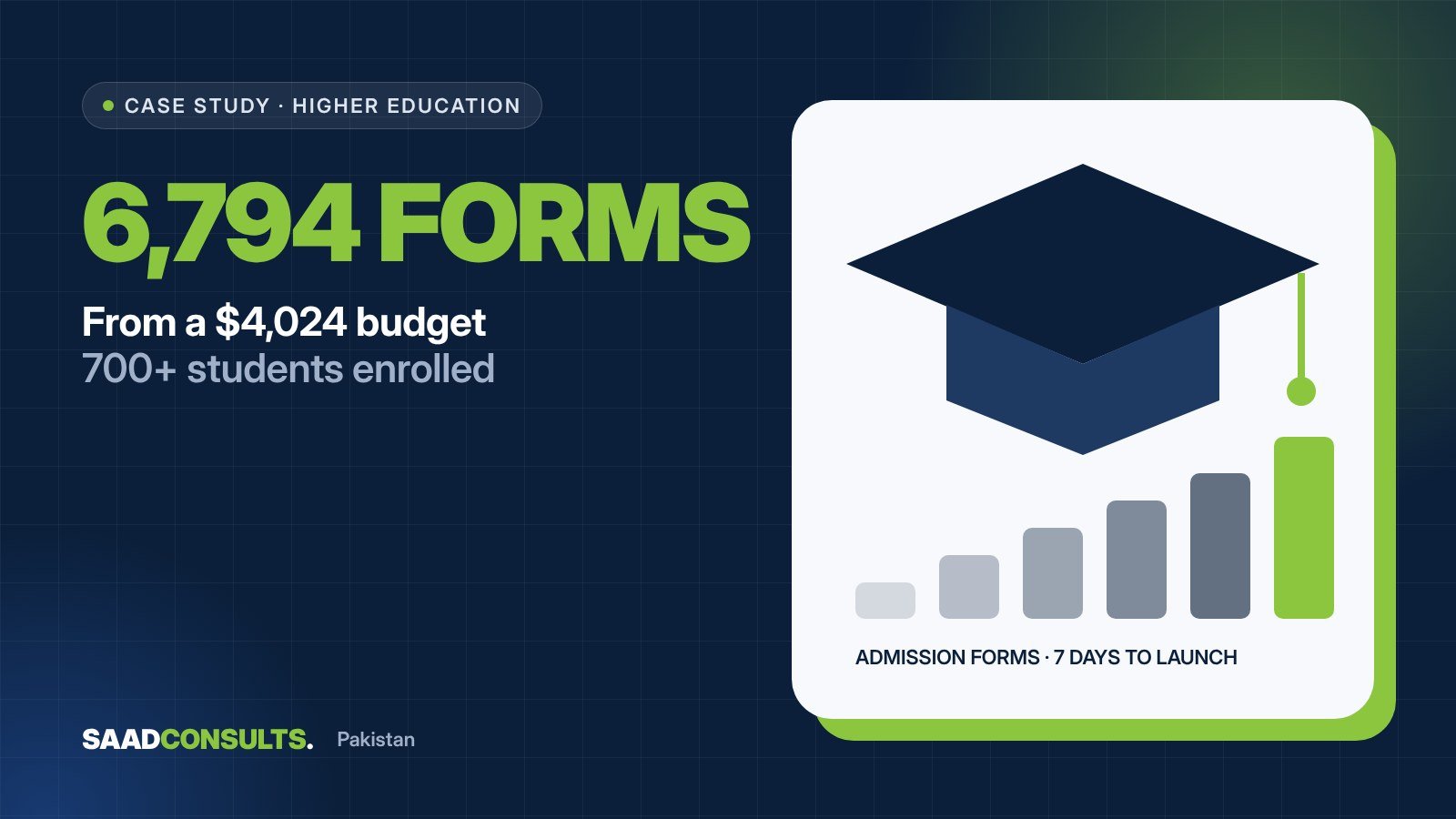
6,794 admission forms from a $4,024 budget for a regional university
Fake pages, 60+ courses and a tiny budget. Live in 7 days, 700+ students enrolled.
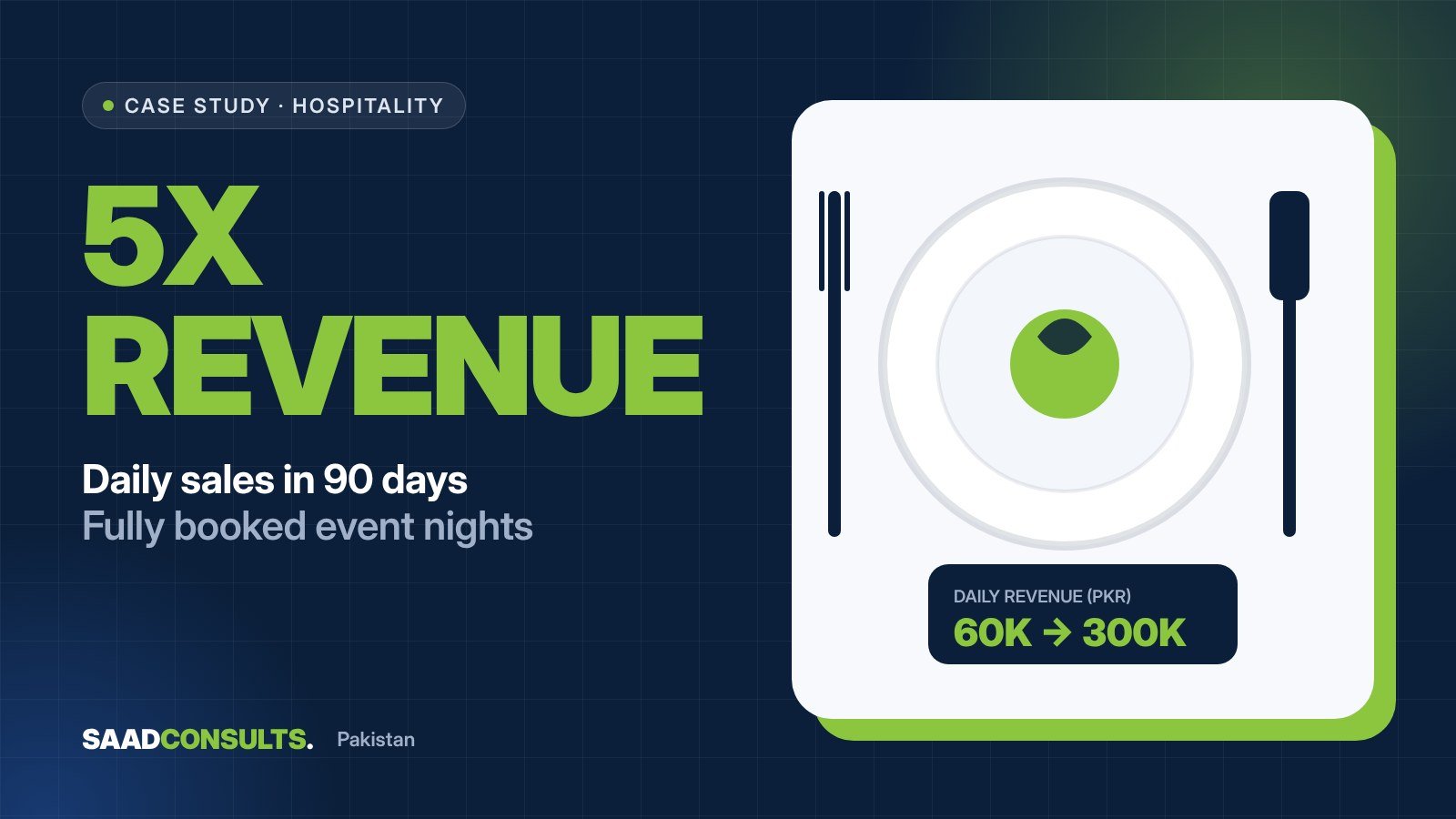
From PKR 60,000 to PKR 300,000 a day: a fine-dining restaurant in 90 days
Two great stories told as one forgettable message. Splitting them filled the tables.
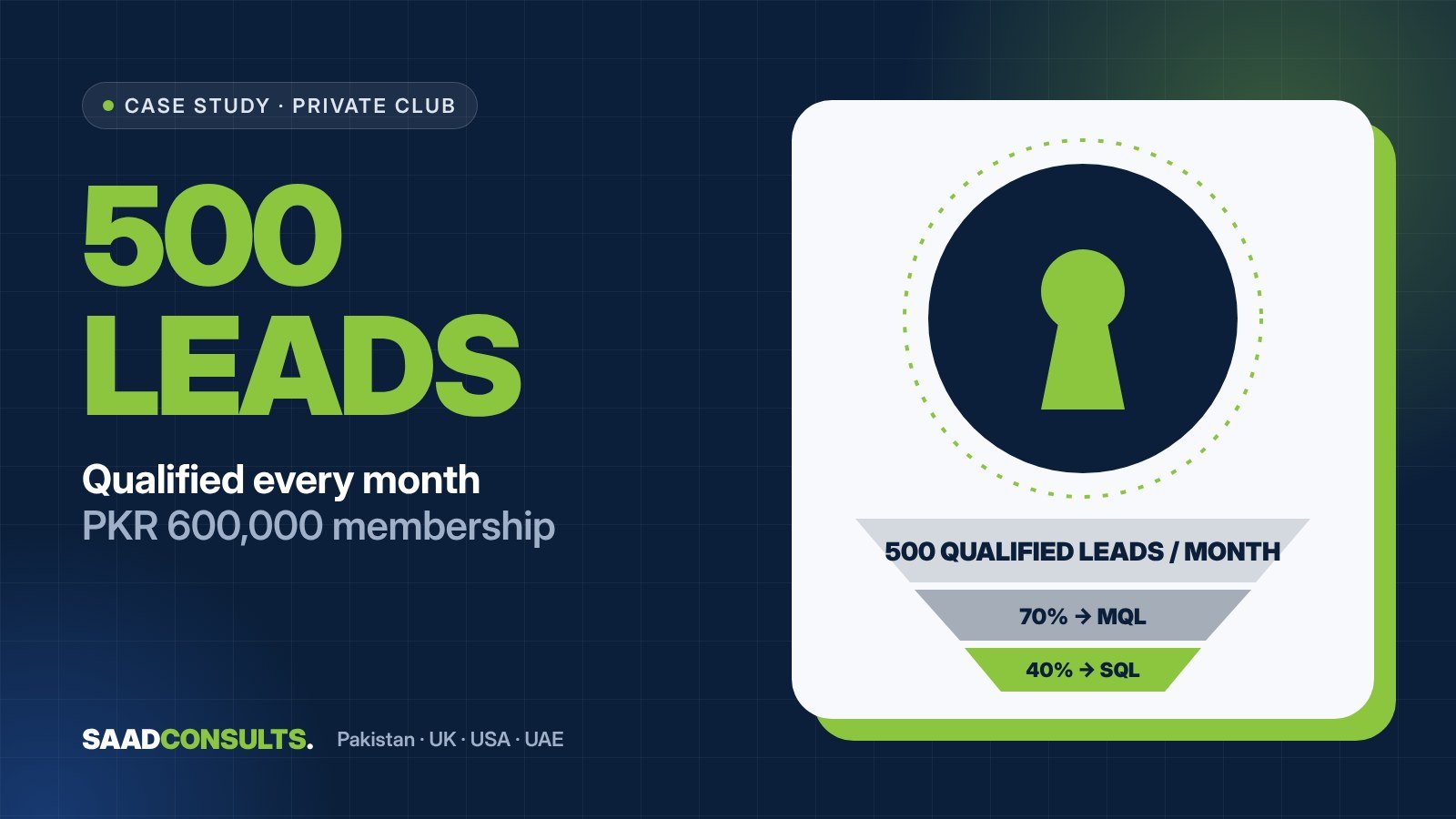
500 qualified prospects a month for a PKR 600,000 private club membership
Selling belonging, not a building. Curation beat reach.
Works best together
Growth rarely comes from one channel. These services pair naturally with this one.
From first call to results in 5 steps
No months of onboarding. We start with a conversation and move fast.
Meeting
A focused call about what happened, your goals and your numbers.
Audit
I check your ads, tracking, website, funnel, sales process and team.
Strategy
Quick wins for breathing space, plus a long-term roadmap.
Execution
I build, launch and fix, with your team or alongside it.
Scaling & reporting
We scale what works. You get honest reports on leads, sales and ROI.
Meta Ads questions
Are Facebook ads still worth it?
Yes, when targeting, creative and tracking are set up properly. Meta remains one of the most cost-effective ways to reach buyers in Pakistan, the GCC, the UK and the USA.
Why are my Meta leads poor quality?
Usually because the form is too easy and the targeting too broad. Qualifying questions and better audience signals fix most of it.
Do you create the ad creative?
Yes. My team produces video, design and copy, or we can work with your in-house creative team.
What budget do I need for Meta Ads?
We'll agree a test budget in your proposal. It needs to be enough to learn quickly without overspending.
Can you run ads targeting overseas Pakistanis?
Yes. I've run campaigns targeting the diaspora in the UK, USA and Gulf for banks, clubs and real estate developers.
How much does it cost to run Facebook ads in Pakistan?
There is no fixed cost; you set the budget and Meta charges based on auction competition, audience and how good your ads are. Costs in Pakistan are generally lower than in the Gulf or UK, but cheap reach means little without sales. Management fees depend on scope, so I send a custom proposal after a free marketing audit.
How do I pay for Facebook ads from Pakistan?
Most advertisers pay with a debit or credit card that allows international online transactions. Some Pakistani banks block these by default, so check your card settings, and be aware that taxes or bank charges may apply on foreign payments. Always pay through your own ad account so you keep ownership.
What is the difference between boosting a post and running Facebook ads?
Boosting is a quick way to show a post to more people, but it offers limited targeting and objectives. Running ads through Ads Manager gives full control over goals, audiences, placements, creative testing and tracking. For leads or sales, Ads Manager almost always performs better; boosting is fine for simple awareness.
Are Instagram ads better than Facebook ads?
Neither is better outright; both run through Meta Ads Manager and usually work best together. Instagram tends to suit visual products and younger audiences, while Facebook often reaches a broader and older audience in Pakistan. I usually let Meta's placements optimise across both, then check results by platform before shifting budget.
What is a good cost per lead on Facebook ads?
A good cost per lead depends entirely on your industry, offer and what a customer is worth to you. What matters is whether leads become customers at a profit. For context, a Texas insurance academy I worked with paid $60 per lead and still achieved 450% ROI, because each sale was valuable.
Why is my Facebook ad not spending?
Usually the audience is too narrow, the bid or cost cap is too low, the ad is still in review, or there is a payment issue. A new ad can also spend slowly at first. Check the delivery column in Ads Manager, broaden targeting and confirm billing works before changing anything else.
Why was my Facebook ad rejected?
Ads are usually rejected for breaking Meta's advertising policies, such as making personal attributes claims, using misleading statements, restricted products or too-good-to-be-true promises. Read the rejection reason, edit the ad and request a review if you think it was a mistake. Repeated rejections can restrict your account, so it is worth getting it right.
What is the Meta Pixel and do I need it?
The Meta Pixel is a piece of code on your website that tracks actions like purchases and form submissions so Meta can measure and optimise your ads. Yes, you need it, ideally alongside the Conversions API for more reliable data. Without it, Meta cannot learn who your buyers are. I set this up as part of tracking work.
How long should I run a Facebook ad before changing it?
Give a new ad around a week or about 50 conversions before making big judgements, so Meta's algorithm can exit the learning phase. Changing budgets or creative too often resets learning and hurts performance. If an ad is clearly failing after a few days with meaningful spend, though, pause it and test something new.
Do Facebook ads work for e-commerce in Pakistan?
Yes, Facebook and Instagram are among the strongest sales channels for e-commerce in Pakistan, especially for fashion, beauty and lifestyle products. Success depends on strong creative, clear offers, trust signals like cash on delivery, and tracking that shows real orders. Watch return and cancellation rates as well as ad cost per purchase.
What is a lookalike audience?
A lookalike audience is a group of new people Meta finds who share characteristics with your existing customers or website visitors. It is a useful way to scale beyond people who already know you. Lookalikes work best when built from a good-quality source, such as purchasers rather than all page likers.
How many ads should I run at once on Meta?
Start with a small number of distinct creatives, usually three to six per ad set, testing different angles rather than tiny wording changes. Too many ads split the budget so none get enough data. Once you know what works, keep refreshing creative regularly to avoid fatigue.
Should I use Facebook lead forms or send people to my website?
Lead forms are quick and cheap but often produce lower-quality leads because they are so easy to submit. Sending people to a landing page usually brings fewer but more serious enquiries. You can improve form quality by adding qualifying questions and using the higher-intent form type. I test both and judge by cost per qualified lead.
Is WhatsApp advertising through Meta effective in Pakistan?
Yes, click-to-WhatsApp ads work well in Pakistan because customers are comfortable chatting before they buy. They can bring high volumes of conversations at a low cost. The challenge is replying quickly and tracking which chats turn into sales, so you need a clear process for your team.
What is ROAS and what is a good ROAS for Meta ads?
ROAS, or return on ad spend, is the revenue you earn for every unit spent on ads. A good ROAS depends on your margins: a high-margin brand can be profitable at a lower ROAS than a low-margin one. For example, a Dubai blinds brand I worked with reached 3.3x ROAS on the same 30,000 AED budget.
What should I look for in a Meta ads agency for my business?
Ask to see real results from similar businesses, how they handle tracking and how they test creative. A good Meta ads manager talks about cost per sale or qualified lead, not likes and reach. Make sure ads run from your own Business Manager so you keep ownership. I have managed campaigns across 26+ industries and can review your current setup before you commit.
Which Facebook ad objective should I choose for sales?
For online sales, choose the Sales objective with the Meta Pixel and Conversions API sending purchase events. For leads, use Leads with instant forms or website conversions. Traffic and engagement objectives look cheap but rarely bring buyers, because Meta finds people who click, not people who buy. Your tracking quality decides how well any objective performs.
How do I target overseas Pakistanis in Dubai and the UK with Meta ads?
Target the country or city, then layer in language settings such as Urdu, interests linked to Pakistan and audiences built from your existing customers. Creative matters as much as targeting: ads that speak directly to expats perform far better. This works well for real estate, education and services back home. I run these campaigns regularly from Pakistan for Gulf and UK audiences.
Why did my Facebook ad account get restricted?
Accounts are often restricted for policy violations, suspicious payment activity, sudden spending jumps, new accounts with no history, or a linked profile being flagged. Check Account Quality in Business Manager for the specific reason and request a review there. Keep your profile verified, use a stable payment method and avoid exaggerated claims in ads. Most restrictions can be resolved if you follow the official review process.
How many days does the Facebook ads learning phase take?
Meta says an ad set exits learning after about 50 optimisation events within a week, so the time depends on your budget and conversion volume. Low-budget ad sets can stay in learning for a long time. Avoid big edits during this period, since major changes restart learning. If you cannot reach enough events, optimise for an earlier step or consolidate ad sets.
Is Meta Advantage+ worth using for Pakistani e-commerce brands?
Advantage+ can work well once your pixel has solid purchase data and you have plenty of creative to test. It hands more targeting decisions to Meta, which suits brands with clear tracking and enough volume. For new stores with little data, a more controlled setup often performs better at first. I usually test both and keep whatever delivers the better cost per sale.
Facebook ads vs TikTok ads: which is better for Pakistan?
It depends on your audience and product. Facebook and Instagram offer stronger targeting, better lead forms and more reliable purchase optimisation, while TikTok can deliver cheap reach among younger audiences when creative feels native. Many brands use Meta for conversions and TikTok for awareness. Test both with clear tracking before moving the bulk of your budget.
How do I make Facebook ads that actually sell?
Lead with the problem your customer cares about, show the product in use, include a clear offer and make the next step obvious. Short videos and real customer footage usually beat polished brand graphics. Test several hooks in the first three seconds, because that is where most ads win or lose. My content and design team creates ad creative built for testing.
Can Meta ads work for B2B businesses in Pakistan?
Yes, especially for reaching business owners and decision makers who scroll Facebook and Instagram like everyone else. Lead forms with qualifying questions, retargeting website visitors and content-led ads tend to work best. Expect longer sales cycles than consumer brands, so connect leads to your CRM and judge results by sales, not form fills. LinkedIn may suit some niches better.
What should I check before scaling a winning Facebook ad?
Confirm the results are tracked accurately, the ad has been profitable for at least several days and your stock or sales team can handle more volume. Then raise budgets gradually or duplicate into new audiences rather than making huge jumps overnight. Watch frequency and cost per result closely, since winning ads tire over time. Have fresh creative ready before performance drops.
Find out where your marketing is leaking money.
Book a free marketing audit. I'll personally review your ads, tracking, SEO and funnel and send you a clear 30-day action plan. No pitch, no obligation.
In a hurry? WhatsApp me