Home/Case studies/Combat sports e-commerce

E-commerce Turnaround Case StudyAd costs at 35%. A slow quarter. 14 days to turn it around.

A global combat sports and fitness brand was spending more to win each sale than its margins could carry. Here's how I stabilised the account in two weeks and kept it profitable for the rest of the year.

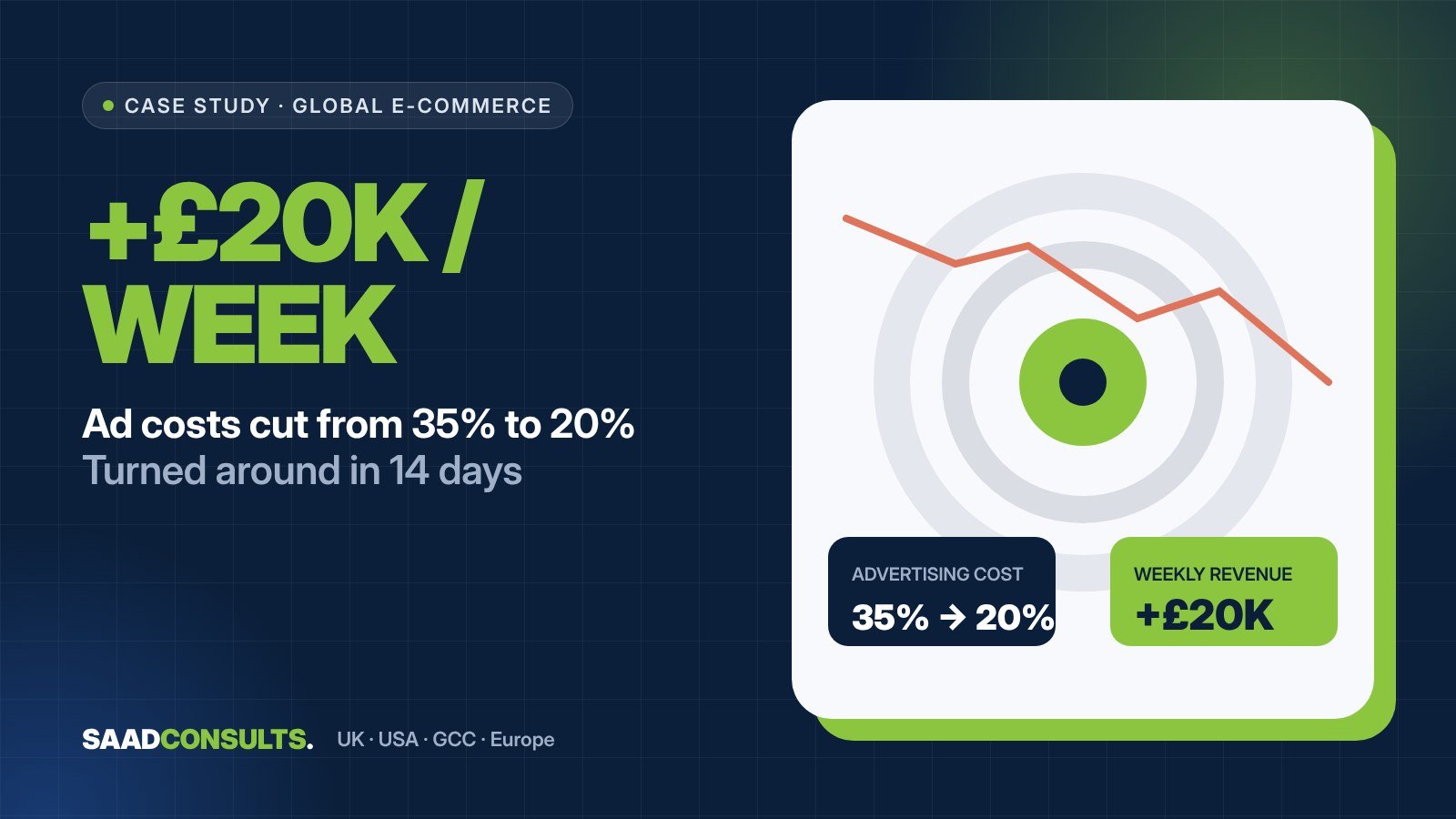
Combat sports e-commerce turnaround case study: ad cost of sale cut from 35% to 20%
35% → 20%Ad cost of sale, held for a full year
+£20KExtra revenue every week
20% → 35%Share of traffic from organic search
2xEmail revenue
Timeline14 days
ChannelsGoogle · Meta · SEO · Email
Markets6 regions

I joined this brand as it walked into one of its slowest quarters. It sells gloves, pads and training gear to fighters across the UK, the USA, the Gulf, Europe, Central Asia and Scandinavia, and it goes up every day against some of the biggest names in the sport.

On paper, the business was healthy. In the ad accounts, it was bleeding. For every pound of revenue, 35 pence was going straight back into advertising. The margin only works at 22 pence or less. Sales were dropping by around 40% a day, and nothing the team tried was holding them steady.

Three problems, all at once

When I dug in, it wasn't one issue. It was three, all landing in the same quarter:

  • The ad accounts were working against the margin. Performance Max and Meta conversion campaigns were chasing cheap clicks instead of high-value buyers, so the spend went up and the order value stayed low.
  • A website migration had broken SEO. The different language versions of the site had started competing with the main domain. Instead of adding up, years of search authority were being split into pieces.
  • Email wasn't pulling its weight. For a brand with a large customer base, email was bringing in just 2% of sales. That's money left sitting in the inbox.

There was also no live view of stock, so ads kept pushing products that were about to run out.

A slow quarter can't wait for a six-week onboarding.

The plan: survive first, then grow

A normal agency onboarding takes weeks. This brand didn't have weeks. I've led turnarounds for a lot of declining businesses, and the pattern is always the same: stop the losses before you try anything clever. So I set a 30-day survival plan with four rules.

Audit everything before touching anything

I went through the Google and Meta accounts line by line. Fixing what's already broken is faster than launching new campaigns on top of it.

Protect the margin, not the volume

Not every product deserves the same budget in a bad quarter. I split the catalogue into three tiers: top performers got aggressive bidding, mid-tier products ran for efficiency, and weak sellers dropped to minimal spend until the account was stable.

Repair the site so organic search could recover

I fixed the migration errors so the language versions supported the main domain instead of fighting it. Authority started flowing back to one place.

Rebuild email in parallel

I rewrote the drip sequence to move people from first purchase to repeat purchase. That's revenue that doesn't cost a penny in ad spend, which matters most when ad costs are too high.

The new campaign structures were live by day three. That speed was deliberate, because every day of delay was another day of losses.

What happened next

Within 14 days, the ad cost of sale fell from 35% to 25%. Over the rest of the year it averaged 20%, comfortably under the 22% target. The account didn't just recover; it beat its own benchmark and stayed there.

MetricBeforeAfter
Advertising cost of sale (ACOS)35%25% in 14 days, 20% average for the year
Target ACOS22%Beaten and held
Weekly revenueFalling+£20K a week (+25%)
Paid engagementBaseline+63%
Organic share of traffic20%35%
Email share of sales2%4%
Time to first new campaignsWeeks (standard onboarding)3 days

Revenue followed. The brand added £20,000 in extra sales every week, a 25% lift, in a quarter that usually goes the other way. Once the migration errors were fixed, organic search grew from 20% to 35% of all traffic, and that traffic costs nothing per click. Email doubled from 2% to 4% of total sales.

Alongside the consumer side, the same work brought in more than 20,000 B2B vendor leads over six months, and search and AI visibility grew to drive around 15% of sales.

The lesson

When ad costs run above what the margin can carry, the problem is rarely the creative. It's the structure underneath it: how campaigns are grouped, what the algorithm is told to value, and whether the website is helping or hurting.

Is your ad account eating your margin?

If your cost of sale keeps creeping up and nobody can tell you why, that's exactly what my free audit looks for. I'll show you where the spend is leaking and what I'd fix in the first 30 days.
FAQ

Your questions, answered

What is ACOS?

ACOS, or advertising cost of sale, is ad spend divided by the revenue those ads generate, shown as a percentage. If you spend 20 to make 100 in sales, ACOS is 20%. Lower is more efficient. It is the inverse of ROAS: a 20% ACOS equals a 5x ROAS. The right target depends on your margins.

How do you reduce ACOS on Google and Meta ads?

Start with an audit, then push budget towards products and audiences that sell profitably. For this brand I grouped products into tiers, bidding aggressively on top sellers, efficiently on mid-tier and minimally on under-performers, and retrained Performance Max and Meta campaigns on high-value conversion signals. ACOS fell from 35% to 25% in 14 days and averaged 20% for the year.

What is a good ACOS for e-commerce?

A good ACOS is one below your break-even point, which depends on your gross margin. If your margin after product and shipping costs is 40%, an ACOS above 40% loses money on the first order. Many brands target well below margin to leave room for profit. This brand's target was 22%; it averaged 20% across the year.

How do you turn around a declining e-commerce brand?

Stabilise first, then grow. I audit before changing anything, stop the obvious waste, fix technical issues hurting organic traffic and rebuild retention channels like email in parallel. For this brand, new campaign structures were live by day three, ACOS dropped within 14 days, and weekly revenue rose by £20K, about 25%.

What is product tiering in Performance Max?

Product tiering means splitting your catalogue into groups by performance and margin, then giving each group its own campaign, budget and target. Bestsellers with good margins get aggressive bids; mid-tier products are run efficiently; weak products get minimal spend. Without tiering, Performance Max often spends heavily on a few products while starving profitable ones.

How can a multilingual website hurt SEO?

If language versions are set up without correct hreflang tags, canonical tags and URL structure, Google can treat them as competing or duplicate pages, splitting rankings with your main domain. That happened here after a migration. Fixing the setup helped organic share of sales grow from 20% to 35%. My SEO services include international setup.

How do you increase email marketing revenue for an online store?

Rebuild the automated flows first: welcome series, abandoned cart, browse abandonment, post-purchase and win-back. These run every day and usually earn more than one-off campaigns. Segment by purchase history and send fewer, more relevant emails. For this brand, email grew from 2% to 4% of sales, doubling within 90 days.

What is a healthy share of sales from email for e-commerce?

It varies by brand, but email and retention often contribute a meaningful share of revenue for established stores with good flows. If email brings in only a tiny share, it usually means automations are missing or the list is not segmented. This brand was at 2%, which signalled a gap; doubling it reduced reliance on paid ads.

How quickly can an e-commerce ad account be turned around?

Early improvements can come within a couple of weeks if the problems are structural, such as poor conversion signals or budget spread across weak products. Here ACOS moved from 35% to 25% in 14 days. Lasting results need longer, as this brand's 20% annual average shows. Speed depends on the audit findings and how fast changes can be approved.

Should I cut ad spend when sales slow down?

Not automatically. Cutting blindly can starve your best products and make the platforms relearn. First find where spend is wasted, then move budget from weak products and audiences to strong ones. In this case, the answer was reallocating and improving signals rather than simply cutting, which raised revenue while bringing ACOS down.

What is the difference between ROAS and ACOS?

Both measure ad efficiency, from opposite sides. ROAS is revenue divided by ad spend, such as 5x. ACOS is ad spend divided by revenue, such as 20%. They are inverses: 5x ROAS equals 20% ACOS. Amazon sellers often use ACOS, while Google and Meta advertisers usually talk about ROAS.

How do you grow organic sales for an e-commerce store?

Fix technical issues first, such as indexing, duplicate pages and broken migrations, then improve category and product pages for the searches buyers use, and build visibility in AI search answers. For this brand, organic share of sales grew from 20% to 35%, and SEO and AI visibility came to account for around 15% of sales.

Can you manage e-commerce ads in multiple countries?

Yes. This brand sold across the USA, UK, GCC, Europe, Central Asia and Scandinavia. Each market needs its own budget, currency, language and targets, because costs and buyer behaviour differ. Running them separately prevents one cheap market from absorbing budget meant for more profitable ones. See e-commerce marketing.

Can paid ads help generate B2B leads for an e-commerce brand?

Yes. Alongside consumer sales, this brand also generated 20,000+ B2B vendor and wholesale leads over six months through dedicated campaigns. B2B needs separate messaging, landing pages and qualification, because a reseller asks different questions than a retail buyer. See lead generation services.

How do I know if my e-commerce store needs a turnaround?

Warning signs include ACOS rising above target, revenue falling while spend holds steady, organic traffic dropping after a site change, and heavy reliance on paid ads with little repeat business. If several apply, start with an audit before changing campaigns. A free marketing audit is a sensible first step.

Free marketing audit

Want numbers like these? Start With Your Free Marketing Audit.

Book a free marketing audit. I'll personally review your ads, tracking, SEO and funnel and send you a clear 30-day action plan. No pitch, no obligation.

Or call +92 333 1414145

SaadConsults.Com
Get Your Free Marketing Audit →Free Audit →
Hi.. Lets Generate Some Sales